Here and Now
Here & Now for February 27, 2026
Season 2400 Episode 2433 | 26m 47sVideo has Closed Captions
Watch the entire episode of Here & Now for February 27.
Watch the entire episode of Here & Now for February 27.
Problems playing video? | Closed Captioning Feedback
Problems playing video? | Closed Captioning Feedback
Here and Now is a local public television program presented by PBS Wisconsin
Here and Now
Here & Now for February 27, 2026
Season 2400 Episode 2433 | 26m 47sVideo has Closed Captions
Watch the entire episode of Here & Now for February 27.
Problems playing video? | Closed Captioning Feedback
How to Watch Here and Now
Here and Now is available to stream on pbs.org and the free PBS App, available on iPhone, Apple TV, Android TV, Android smartphones, Amazon Fire TV, Amazon Fire Tablet, Roku, Samsung Smart TV, and Vizio.
Providing Support for PBS.org
Learn Moreabout PBS online sponsorship>> The following program is a PBS Wisconsin original production.
>> No new deals yet for education funding or property tax relief out of the Capitol.
As lawmakers turn into candidates and campaigns turn their attention to the 2026 elections.
I'm Frederica Freyberg tonight on "Here& Now", a superintendent tells us why districts of all sizes are urging property tax relief.
The candidates for governor weigh in on state prisons.
Charles Franklin shares the latest Marquette Law School poll and a new focus looking at why Wisconsin is falling behind in math.
It's "Here& Now" for February 27th.
>> Funding for Here and Now is provided by the Focus Fund for Journalism and Friends of PBS Wisconsin.
>> As the legislature and governor remain without a deal on using the state budget surplus for property tax relief, five school districts, teacher unions, parents and students filed a lawsuit this week against the legislature for failing to adequately fund public schools in Wisconsin, as required by the state constitution.
The sweeping lawsuit states it's not a new issue, but has gotten much worse over the last 25 years.
The complaint says state aid to public school districts this year is $2 billion less than the inflation adjusted number from 2009.
You don't have to explain that to our next guest.
He's the superintendent of Sauk Prairie schools, which is among districts not part of that lawsuit that have been beseeching lawmakers and the governor to both further fund schools and provide property tax relief.
Superintendent Jeff Wright joins us now.
And thanks very much for being here.
>> Thank you.
Glad to be here.
>> So how disappointed were you and other superintendents when the Assembly adjourned without hatching this plan?
>> Well, we were really disappointed and in part because they adjourned the session and the second or third week of February, and we talked about that with some of our students, that that would be similar to us ending the school year after homecoming, that there's so much of this year left that the legislature and the together to solve these long standing problems, not only using the state surplus that exists now to solve property tax relief and school district finance in the short term, but also sitting, sitting down and doing the serious work of trying to address long term concerns about the state's school finance formula.
>> So so you described the lawsuit as addressing those long term issues with the school financing system, and that you're what you're calling for is immediate action to use the state surplus to both help property taxpayers and schools.
Describe what the urgency is.
>> Well, the urgency is in part, the fact that we have this unique moment where the state has more has more money in revenue than it anticipated.
And so there is a surplus that we could be using to not only address property tax relief, but also some of these school funding issues.
Six districts in Sauk County recently put out a letter to the governor and the legislature asking for this action.
We're a really unique mix of of school districts.
We're in Wisconsin's most purple county.
And I think what we're saying is that if we as school districts that are as politically diverse as those in Sauk County, can get together and ask for some urgency on this issue, that hopefully the legislature will also take this up in a special session and act right away.
>> As to the issue of why we're putting all the pressure on property taxpayers at the same time that we're collecting more money.
Why do you think that is?
>> Well, school finance is something that we could spend hours talking about with your viewers.
It's incredibly complicated, but every time that the state raises the revenue limit, what student what what schools can spend per student, that money has to come from somewhere.
And often it's come from the state budget.
But recently, the legislature has decided, yes, school districts can spend a little bit more, but that $325 has to fully be funded by local property taxpayers.
And so that's why we're asking with some urgency, that before we go into another budget year, instead of passing on that responsibility for funding this to local property taxpayers that are already stretched incredibly far, use some of the state's surplus to not only address school funding, but also give that property tax relief.
>> How does this situation kind of pit property taxpayers against schools?
>> Well, there's a direct connection between the state not funding schools the way it used to, and an increased reliance on property taxpayers to pay that bill.
This year's high school seniors, the year they were born was the last time that the revenue limit was tied to inflation.
And so under the Tommy Thompson administration, under the Jim Doyle administration, the revenue limits for school districts were tied to inflation.
But when this class of seniors was born 17 years ago, the revenue limit and inflation was detached.
And so every year of their life, the amount that a school could spend educating a child has fallen further and further behind inflation, to the point where now it's over $3,500.
That gap between what would have been spent in real dollars when those children were born, and what a school district gets to spend now as their seniors.
>> If hundreds of districts under this scenario are forced to go to referendum to get the money, they need to operate and stay afloat, what's the tipping point for voters?
I mean, when do they just say no?
>> Well, we're certainly seeing that for many communities.
We've already reached that point that as the state has chosen not to allow revenue limits to go up and school districts have turned to local property taxpayers for referendums to operate schools, there are many districts that have gone year after year to referendum, hoping that they could get one passed and have not been able to do so.
And some of the districts in the state have turned to their taxpayers and said, if we don't pass this, we're going to have to consider dissolving the district and sending our students to other communities for schools or be absorbed by another district.
I think that that tipping point for a lot of communities is that we know that schools are often the lifeblood of a small community, and that if we let the school fail, if we let the school close, there's very little that's going to be attracting new families to our community in the future.
But for many communities, they're already at that tipping point, which is why this lawsuit has been filed and why other districts are signing on to the letters like ours, asking the legislature to act immediately.
>> What about the argument from some Republicans that what's needed is reform, not guaranteed funding to prop up a broken system, especially in light of kind of falling test scores?
>> Well, I hope that we can we can talk about schools and not just talk about money, that it it's an honor to do this work and to be a trusted partner with a parent in watching their child grow and learn.
And if a school can't show their show the community how their school, how their students are growing, that's on us.
We need to make sure that we're doing that.
We also need to be incredibly transparent with how we're spending taxpayer dollars.
Share the audits with our community.
Share the budgets.
Because there's a lot of trust, not only in the relationship that we get to have watching a student grow and learn, but also the trust that a community has to place in us as school leaders and how we're spending the taxpayer dollars to educate Wisconsin's children.
>> We leave it there.
Superintendent Jeff Wright, thanks very much.
>> Thank you.
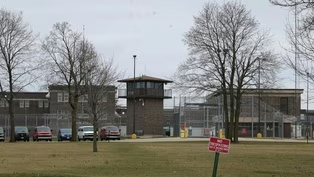
>> Governor Tony Evers $500 million plan to revamp the state prison system is underway, but only in the most modest fashion.
Earlier this year, a bipartisan group at the State Building Commission released $15 million to start the years long process to eventually close down green Bay Correctional.
Tonight, as we continue our look at some of the biggest issues in the race for governor "Here& Now", senior political reporter Zac Schultz asks the leading candidates for governor if they would carry through Governor Evers corrections overhaul.
>> Green Bay Correctional and Waupan Correctional are two of the oldest prisons in the country still holding inmates, and studies have shown time and again the buildings are not safe for staff or prisoners.
But building new prisons is expensive, and closing down prisons is not politically expedient.
When every election cycle can quickly shift focus to law and order.
So we asked nine of the leading candidates if they would continue.
Governor Evers plans to reform Wisconsin's prison system.
>> I watched that plan be developed.
I have great, great respect for the team at the Department of Corrections who has put that plan together, along with Governor Evers administration, and we need to get moving on that.
You know, it might not be perfect, but nothing ever is when it comes to corrections.
It's a very difficult situation.
And but we need to make improvements on that.
We need to modernize that system.
It is costing us more now to keep the old system in place than it would be to build a new system and get that rolling.
>> Yeah.
So with green Bay, I know that there are a number of safety concerns.
Structural concerns, of course.
I mean, we can't have people or even whether you're a person who's housed at that facility or a person who's working at that facility, we can't people have people in substandard conditions.
So the overhaul of smaller facilities, more regional facilities, I think that might get us to a place where we can more effectively rehabilitate people.
And that has to be our baseline as well, ensuring that rehabilitation actually happens.
>> I think it's important to look at reducing our prison population, while also ensuring that those who are at the Department of Corrections have opportunities to be able to transition and be safe in their work environments.
And so I will certainly look at some of the plans that the governor has now.
But overall, it's important that we look at transition programs and ways that we can keep those who are incarcerated and those who are working in our prisons safe.
>> Absolutely.
We have to absolutely have to make sure that we are doing what's best for people within our prison system and corrections system, and it needs an overhaul.
>> And I think we need to continually try to to create that balance where where there is need for secure detention and where there is need for employees of the corrections system to have the right tools at their disposal.
We need to create those, because we have these 150 year old prisons and things that we need to do to make investments on.
But at the same time, I think we also need and I think the governor has done this too.
We need to look at the alternatives to incarceration.
We need to work with our partners at the local level to ensure that there is a pathway that doesn't just ensure that what we have is the last resort, which is where we're putting people in prison and locking them up.
>> We have to reform the Department of Corrections.
Governor Evers, when he ran against Governor Walker, he said, I am going to take care of that, including Lincoln Hills, and he has not followed through on it.
And when you look at the debacle over in Waupan with, I think there's been a couple deaths over there, I mean, that's unacceptable.
We need reform in the Department of Corrections, and I will I don't know that I'll go in the same direction as Governor Evers, but clearly we have to reform our correctional system.
revisit how we do corrections here in the state of Wisconsin.
When I served in the state legislature years ago, you know, Grover Norquist came to Wisconsin to talk about how we needed to do criminal justice reform.
And there's not many times where I can say I agree with Grover Norquist.
And so we should be looking at how do we make sure that those, those, those, those less violent offenders aren't just spending as much time in our care, which costs us a lot more money to have them in prison?
rightsize the corrections system, and we have to get serious about safety in this state.
We have pursued policies that are not only not evidence based, but that really undermine public safety.
It is how we incarcerate people.
It is how long, and it is the lack of services and training to help people succeed when they actually reenter society.
We spend an ocean of money on this, and we are not getting the safety return that we deserve.
>> Reporting from Madison.
I'm Zach Schultz for "Here& Now".
>> Notwithstanding our efforts to bring you the positions of the candidates for state, Supreme Court and governor in our weekly reporting on issues in the races, a new Marquette Law School poll this week shows two thirds of voters are undecided between judges Chris Taylor and Maria Lazar in the April 7th election for Supreme Court.
Likewise, in the large field of Democratic candidates in the lone Republican in the race for governor, which will be narrowed in an August primary, the poll shows no runaway leader, with most candidates not well known by voters.
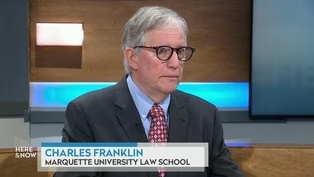
Poll director Charles Franklin joins us now.
And thanks for being here.
>> So what does it say about voter engagement, when roughly 66% of your respondents don't know enough about the two Supreme Court candidates less than two months away?
>> Yeah, I think it's first of all, it is unusually low engagement this year.
It's not nearly as high as it was a year ago or in the gubernatorial races as it was in, say, 2018 or 2022.
So we do seem a little less engaged right now.
Some of that is that the advertising has not really kicked in in the Supreme Court race compared to where it was a year ago.
This time, only 6% said they'd heard or read a lot about the Supreme Court race a year ago.
That was 39% at this same time in February.
So I think those things will pick up.
But we're getting started a bit slower than we did a year ago.
>> I'll say in the governor's race, most of the eight major candidates between 52 and 82% who took your poll have not heard enough about them.
Of course, former Lieutenant Governor Mandela Barnes is a little better known.
But should anyone take stock in this kind of poll number at this point.
>> I think the stock you take is the disengagement that all of these candidates have work to do, introducing themselves to voters.
Mandela Barnes is the best known by a good bit, followed by Tom Tiffany, followed by Sarah Rodriguez on the Democratic side.
But all of them have the chance to introduce themselves to voters over the next however many eight months it is seven months till the primary, but that will take time.
And often we see that in primaries people don't really tune in until June.
>> On the issues which you also pulled on.
Data centers, as we all know, are a hot topic right now.
You looked at how people viewed the cost benefit analysis of them.
Your results show respondents from all parties think the costs outweigh the benefits, but who wins the day here?
Public opinion or moneyed interests?
>> Well, moneyed interests are certainly important, and the development of these centers is an economic priority for a whole industry.
But the public has not been convinced.
I think the proponents of data centers have failed to convince the public that those benefits are real.
People recognize that technical jobs and tax revenue for communities are important benefits, but they look at water usage as a big concern cost.
They also are concerned about electricity.
Maybe surprisingly, the second biggest cost people point to is developing AI and saying we shouldn't develop artificial intelligence.
So there's a real need to communicate with voters about what those benefits are or the the critics end up with the upper hand on this.
And we've seen a big movement away from data centers since October.
When we first asked.
>> On immigration, the way its enforcement has rolled out is not favored, with 44%, just 44% approving and 5,456% disapproving, do you think?
But for the Minneapolis surge and the shooting deaths by the Border Patrol of two people, these numbers would look different.
>> I think that the events that have been going on in Minneapolis have certainly tilted independents away from the way they view ICE Republican approval of ICE is still quite high in the 7070 plus percent range, 80% actually on ICE.
But Democrats are deeply negative.
More importantly is independents.
Now three quarters are negative about ICE.
>> Then there's the issue everyone is talking about.
That is property taxes versus school funding.
Your poll results show 60% of registered voters prefer reducing property tax, while 40% would rather spend more on public schools.
Now, you have been pulling on this for for years.
Is this newly resonant?
>> Now it.
>> Is, but it's been building for a long time.
We've seen this trend move.
We've done, I think it's 26 polls on this since 2012.
This is the biggest ever that say property taxes are more important.
60 to 40.
We saw a big majority saying schools were more important in 2015 to 2019, but those trends have moved in opposite directions.
Property taxes are really ascendant right now.
>> Interesting.
Charles Franklin, thank you so much.
>> Thank you.
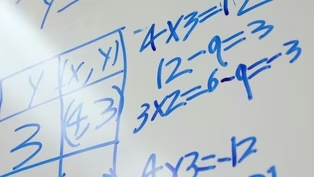
>> Along with the number of education bills that stalled in the legislature, one authored by State Representative Karen Hurd, would have provided year round testing and tutoring for students falling behind in math despite not gaining enough support this past legislative session.
The push will continue to help K through eighth grade students in Wisconsin struggling with math tonight.
Here and now, reporter Murv Seymour takes us to the classroom and the big screen to learn more about statewide struggles and success with math.
>> This evening, we're going to do the film screening of Count It Out.
>> Tonight is movie night at the Urban League of Madison's Black Business Hub.
>> We brought this film to Madison, to the community so that we can be a contributor with changing the dialog.
>> It's a packed house for the first ever public showing in Wisconsin of Counted Out, a documentary about the importance of math.
>> Because math is all around us, it is something that maybe many of us might have had a negative experience with when we were in school, but we want to change that narrative.
>> The film features two University of professors.
Erika Bullock is one of them.
>> I love teaching math, for sure.
>> By her estimate, this is about her 15th time participating in a counted out screening.
>> When people are thinking about screening it, they think about, okay, this is going to help parents to understand how they can mathematics.
It's really difficult to convince people that there's value in math, even though we use it all the time.
>> Math is everywhere.
>> Understanding math is foundational, just under, you know, being able to function in the world.
>> Based on the numbers.
Educators everywhere agree Wisconsin students need to do better in math.
According to Wisconsin's forward exam, the test used to assess how well students are doing in the classroom, just over half in grades three through eight are proficient in math.
In Milwaukee schools, the number is just over 20%.
>> I would say this question of math and numeracy is every bit as important as a conversation we've had around literacy.
>> Welcome to the Milwaukee offices of City Forward Collective, a nonprofit team of educators and advocates led by Colleston Morgan.
understand and analyze so many different aspects of our world.
>> Collectively, their mission is to eliminate educational inequity while providing students access to quality schools.
City Ford also tracks state and national test scores of students at public and private schools statewide.
A father of two, Colleston Morgan tells me he tracks his own kids in their journeys with math.
>> My fourth grader probably just got through her times table.
She's working on advanced multiplication division.
My sixth grader is doing her math skills as well, right?
What keeps me up at night is thinking about the tens of thousands of students across our state who maybe aren't getting that same level of instruction, who maybe aren't getting that same level of attention.
At home.
We get to the point where we don't even think about the ways in which we're adding and subtracting, multiply and divide.
>> And we say, okay, it's three hours away.
If I go about 60, I'll get there.
Those kinds of calculations, we don't see those as mathematical, really calculating a discount in a store or, you know, kind of visually eyeing something to see.
Okay, does this look about the same size.
>> In politics?
Strategizing winning campaigns and mapping voting districts involves math.
>> This is a battleground state.
I need to invest my resources because there is something here that the data has shown that says this is a possibility for me.
We're using algorithms in order to determine if somebody will recommit a crime and return back to prison.
And maybe for every disciplinary infraction, I'm going to subtract ten points.
>> Math is at the center of managing Covid and other diseases.
>> You have one person who is infected, and then that person sits in a room with 30 people and now 30 people are infected.
>> Walk sign is on to cross park.
>> Even something as mundane as crossing a busy street involves mathematics.
>> I'm thinking about.
>> You got 30 seconds to get across the street.
>> So I'm looking at the distance.
before the light turns red?
>> Do I need to run?
Do I need to walk fast.
>> On the street?
You're driving 35 miles an hour.
>> Suitcase in my hand.
Can I make it?
>> These foundational the basis for your ability to access and enter.
And if anything, they'll only become more important.
>> People need to hear that there are places in education that are working.
>> The Notre Dame Academy on Milwaukee's south side is one of those places.
>> There's a special math culture here, and it's evident in the numbers.
>> That's the school's president, Patrick Landry, speaking about the culture of learning at Notre Dame.
>> Math is cool here.
Math is fun.
When you ask the kids their favorite subjects, I'd say 70% of them are saying math.
>> You each have a problem.
It's up front here.
>> Welcome to Mrs.
Frome's eighth grade all boys algebra class.
>> To make sure that whatever you input for X, whatever the outcome is for Y, then okay.
>> Where the proof is all in the numbers, student Jonathan Todd will tell you, in this classroom, the passion for math adds up to positive perfection.
>> The teachers here are just amazing.
I think that like the best teachers in the world.
>> Sixth through eighth grade boys at Notre Dame scored a perfect 100% in math on the state's Ford exam.
It's girls, 70% students at other Milwaukee schools in the same grades scoring at 20%.
>> So is your X and Y is going to be the same as Jonathan's.
Yes or no?
>> Jonathan wants to be a math teacher some day.
>> The reason why people struggle with math is because you haven't learned it yet.
>> He believes the derivative of school Dame is a combination of strict teaching discipline, students supporting each support.
And it's okay to make mistakes.
He and his classmates say.
They learn from them.
>> There's a coefficient in front of the variable y.
>> Outside the classroom, Jonathan says.
He uses math all the time, even when he plays basketball.
>> If I'm like the three point line and my brain is like, how much force I need to put in the ball, how what angle I need to go upwards like this into the net.
come up and give me an example.
>> After more than 30 years in the classroom, Angie says teaching how students learn has changed a lot today.
It involves more problem solving, more critical thinking.
>> Maybe you and I were kids where we just like, okay, what is two times five is ten?
What is it was it's more more than computation.
It's more conceptual.
You know, you have to really think about and use it for everyday situation, everyday life.
>> I have numbers in front of me all day financial data, fundraising trends, enrollment and demographic data test scores.
>> You each have a problem.
It's up front here.
>> At Notre Dame School of Milwaukee, the formula for than their peers at other schools involves a simple equation centered around the basics.
>> Fluency and subtraction, addition and multiplication, and percents, decimals and fractions.
And if students don't have those in second, third, fourth grade, it makes any type of more complicated or more advanced math.
In middle school or high school really hard.
>> We've got to make sure that teachers are getting the right training.
We've got to make sure that students are showing up.
>> I think it's a partnership between the home and school.
>> As long as it looks nice and neat and organized.
>> In your notebook.
>> Capiche?
Prasch.
All right.
as you can see in some of our data, I think really remarkable things can happen.
>> Reporting from Milwaukee I'm Murv Seymour for here.
>> Now for more on this and other issues facing Wisconsin, visit our website at PBS Wisconsin and then click on the news tab.
That's our program for tonight I'm Frederica Freyberg.
[MUSIC] >> Funding for "Here& Now" is provided by the Focus Fund for Journalism and Friends of PBS Wisconsin.
 New
NewCharles Franklin on an Early 2026 Poll of Wisconsin Voters
Video has Closed Captions
Clip: S2400 Ep2433 | 5m 37s | Charles Franklin on polling on 2026 candidates for Wisconsin Supreme Court and governor. (5m 37s)
 New
NewHere & Now opening for February 26, 2026
Video has Closed Captions
Clip: S2400 Ep2433 | 1m 4s | The introduction to the February 26, 2026 episode of Here & Now. (1m 4s)
 New
NewJeff Wright on School Referendums Causing Property Tax Hikes
Video has Closed Captions
Clip: S2400 Ep2433 | 6m 49s | Jeff Wright on how referendums for education funding are causing property taxes to rise. (6m 49s)
 New
NewEveryday Life Plus Constant Decisions Equals a Need for Math
Video has Closed Captions
Clip: S2400 Ep2433 | 7m 41s | Many students struggle to learn mathematics as educators emphasize numeracy in daily life. (7m 41s)
Wisconsin's 2026 Governor Candidates Consider State Prisons
Video has Closed Captions
Clip: S2400 Ep2433 | 5m 13s | Candidates in the 2026 race for governor on a plan to overhaul the corrections system. (5m 13s)
Providing Support for PBS.org
Learn Moreabout PBS online sponsorship
- News and Public Affairs

Top journalists deliver compelling original analysis of the hour's headlines.

- News and Public Affairs

FRONTLINE is investigative journalism that questions, explains and changes our world.











Support for PBS provided by:
Here and Now is a local public television program presented by PBS Wisconsin