
July 6, 2026 - PBS News Hour full episode
7/6/2026 | 57m 46sVideo has Closed Captions
July 6, 2026 - PBS News Hour full episode
July 6, 2026 - PBS News Hour full episode
Problems playing video? | Closed Captioning Feedback
Problems playing video? | Closed Captioning Feedback
Major corporate funding for the PBS News Hour is provided by BDO, BNSF, Consumer Cellular, American Cruise Lines, and Raymond James. Funding for the PBS NewsHour Weekend is provided by...
July 6, 2026 - PBS News Hour full episode
7/6/2026 | 57m 46sVideo has Closed Captions
July 6, 2026 - PBS News Hour full episode
Problems playing video? | Closed Captioning Feedback
Where to Watch PBS News Hour
PBS News Hour is available to stream on pbs.org and the PBS app.
Providing Support for PBS.org
Learn Moreabout PBS online sponsorshipAMNA NAWAZ: Good evening.
I'm Amna Nawaz.
Geoff Bennett is away.
On the "NewsHour" tonight: NATO allies promise to up their military spending.
The question at this week's summit in Turkey, can they deliver?
Controversy at the World Cup after a call from President Trump prompts FIFA to reconsider, then reverse the suspension of a team USA star.
And the White House rolls out investment accounts for children, but questions remain about who they'll benefit most.
AMY MATSUI, National Women's Law Center: We already have extremely significant wealth gaps by income, by race, by gender.
And the way that this policy is structured, it's not going to narrow them.
It has the potential to widen them.
(BREAK) AMNA NAWAZ: Welcome to the "News Hour."
President Trump has often been a proud disrupter on the world stage, and today was no different.
He acknowledged today that he intervened directly with the president of FIFA, which led to the overturning of a penalty that would have banned a star American striker from tonight's World Cup match.
In response, some European soccer leaders are questioning the integrity of the entire tournament.
And, tonight, President Trump is departing for a pivotal summit with NATO allies, after a year in which he's questioned European countries' sovereignty and doubted the very utility of the alliance.
We will get to the soccer controversy in just a moment.
But, first, Nick Schifrin joins me from Ankara, Turkey, where the NATO summit will take place.
So, Nick, what are administration officials saying ahead of this pivotal summit?
NICK SCHIFRIN: Amna, as one senior official put it to me, it is -- quote -- "Show me the money time."
It was one year ago at the Hague summit that all NATO leaders pledged to spend 5 percent of their GDP on defense, and President Trump declared the U.S.'
military presence in Europe was -- quote -- "not a ripoff."
That was a good day for NATO.
But, since then, it has been a bad year.
And the president's national security strategies criticize European -- quote -- "civilizational erasure."
The president threatened to seize Greenland, which, of course, is an autonomous part of Denmark.
Even this weekend, Amna, as a senior administration official was briefing reporters, the official said that the U.S.'
acquiring Greenland would still be -- quote -- "the best way" to meet the defense needs of NATO.
President Trump has also questioned the very reason for the alliance's existence after Europeans resisted helping the U.S.-Israeli war with Iran.
And the Pentagon indicates that they will draw down troops and bases from Europe.
And so European officials arrive here both knowing that if they want to placate President Trump -- and that is an if -- they will have to present what Mark Rutte, the secretary-general of NATO, today called clear, concrete, and credible plans to reach that 5 percent goal.
As that senior administration official put it to us, the U.S.
is no longer interested in burden-shifting.
They are talking about burden-sharing.
And that really indicates how much the historic U.S.
and European security ties, Amna, have begun to fray.
AMNA NAWAZ: And so, Nick, what do you anticipate will hear in the summit?
Will they acknowledge that sort of momentum and shift?
NICK SCHIFRIN: Privately, Amna, European officials do acknowledge this, but, publicly, they are much more careful, saying what one European official told me today would be a -- quote -- "more European NATO."
But there's a different tone here.
Amna, last year European officials arrived here describing an effort, an attempt, a hope, to try and keep the U.S.
committed to Europe.
Now they acknowledge that the Europe -- is going to reduce its presence in Europe.
So their goal is just to minimize the damage of the transition.
There are more than 70,000 U.S.
troops in Europe.
And if the U.S.
withdraws quicker than Europe can mobilize, that could create a security vacuum that would make Europe vulnerable.
What Europe wants is, frankly, what it doesn't always get, predictability and collaboration.
But, as always, today, Rutte played his Trump whisperer role, and he praised what he called the president's forcefulness.
MARK RUTTE, NATO Secretary-General: President Trump has been extremely forceful, encouraging us to do this.
You could argue that he is the first president of the U.S.
since Eisenhower who was able to come to this situation where the Europeans and the Canadians will spend the same as the as the Americans.
This equalization was a wish for 50, 60 years, and now it's happening, and I think in large part through his leadership.
NICK SCHIFRIN: The irony here, Amna, is that European defense spending and capabilities are growing at the exact same time that tension within the alliance is growing, mostly because of President Trump's rhetoric.
AMNA NAWAZ: Nick, meanwhile, we know, as you have been covering, one of the topics at the summit beyond NATO will be Ukraine.
What do we expect to come from these meetings when it comes to that ongoing war?
NICK SCHIFRIN: I mean, it's certainly a topic that European officials are desperate to present a united front on.
But Ukraine is extremely vulnerable right now to Russian attack, as we saw overnight.
A Russian barrage of missiles and drones hit Kyiv.
All of Russia's ballistic missiles struck their targets.
That means that Kyiv has run out of Patriot air defense.
The Russian attack killed at least 22 people.
President Trump will meet Ukrainian President Volodymyr Zelenskyy here on the sidelines of NATO.
And Zelenskyy, of course, will emphasize getting more European and U.S.
air defense, as the U.S.
and Europe are also talking about some joint models, joint production in the defense industrial base.
AMNA NAWAZ: And, briefly, Nick, before we let you go, what are we expecting from President Trump in the way of an announcement tomorrow alongside the Turkish leader, Erdogan?
NICK SCHIFRIN: So, they -- the two will meet.
And Turkey has been asking for two major military parts from the United States, engines for Turkish military jets and also being back into the American F-35 military jet program.
You will recall, Amna, of course, that Turkey was removed from the program and sanctioned during the first Trump administration after it refused to give up air defense missiles provided by Russia.
U.S.
officials are hinting, although not confirming, there could be progress to allow Turkey back into the F-35 program.
That is something that has split Capitol Hill.
It's split experts.
Israel has come out against it.
But it's something, Amna, that Prime Minister Erdogan has made such a key priority in his personal dealings with President Trump.
AMNA NAWAZ: All right, that is Nick Schifrin reporting live from the site of the NATO summit in Ankara, Turkey.
Nick, thank you.
All right, let's turn our attention now to President Trump's involvement in another international affair.
That's the World Cup.
The U.S.
takes on Belgium tonight with star striker Flo Balogun on the pitch.
Balogun was given a red card in last week's game against Bosnia and Herzegovina, meaning he would miss tonight's game.
Then Trump intervened, and FIFA reversed Balogun's suspension, leading to controversy and outrage.
For more, we turn now to our White House correspondent, Liz Landers, as well as Leander Schaerlaeckens, who's been covering the cup for ESPN and The Guardian, is the author of the book "The Long Game: U.S.
Men's Soccer and Its Savage, Four-Decade Journey to the Top or Thereabouts."
Leander, I will turn to you first, because you have covered soccer for a while.
For context here,how unusual is it for a red card suspension to be handed out during a World Cup match and then reversed mid-tournament?
How often does that happen?
LEANDER SCHAERLAECKENS, The Guardian: The rules are very clear here.
You get a red card, you're suspended for the next game.
In fact, the last time I was on your very show, I was asked, is there any chance he will play in the next game?
And I said no, because there wasn't.
This has happened before in the World Cup.
In 1962, a Brazilian player called Garrincha was kind of spared his automatic suspension.
It hasn't happened since then.
There's a little bit of a recent precedence, where Cristiano Ronaldo was supposed to miss the first two games of this World Cup because of a suspension.
But then he went to the White House along with his Saudi employer, Mohammed bin Salman, and suddenly that suspension went away and he was ready to go in the opening games of this World Cup.
But this is not supposed to happen.
There is a huge uproar around the world about this, and rightly so, because what's happened here is that a wrong has been righted in the soccer sense, because it shouldn't have been a red card.
And the U.S.
played down a man for half-an-hour and was going to miss its best striker for this Belgium game.
But in fixing that wrong, a greater wrong has now been inflicted, and the Belgians understandably are upset.
AMNA NAWAZ: So, Liz, how did this happen?
The president has come out and said he did make a call, he did intervene.
What do we know about what he said?
LIZ LANDERS: President Trump and the administration apparently sprang into action after this happened last week.
And the president talked about this in a lot of detail today in the Oval Office.
He said that he saw the play during the game last week and he thought it wasn't a foul, and instead it was just, as he said, two great athletes that got tangled up.
He called the player a very vital player when someone explained to him what the red card meant, and thought that the red card was very unfair.
So he said in the Oval Office today that he did call FIFA President Gianni Infantino, and here's how he described that phone conversation.
DONALD TRUMP, President of the United States: I think it would have had a big stain.
And I relayed just that feeling.
I didn't tell him what to do.
I can't tell him what to do, but -- and I don't believe he made the decision.
I think it was a committee that made the decision.
And they made the right decision.
LIZ LANDERS: The president said that he did ask Infantino to review the red card and to review what had happened during the game.
And within about an hour-and-a-half of the president making these comments today, we got a statement from the FIFA president, and he said in part in this statement -- quote -- "During our conversation, I explained that there was an ongoing legal process involving FIFA's independent judicial bodies, and that the case would be decided in due course by the competent bodies.
That is how FIFA's system works, and it is a principle that I will always uphold."
So, defending the autonomy of the organization there.
But these two men have a very close relationship.
FIFA took up offices in the Trump Tower.
Infantino attended President Trump's inauguration.
And, of course, people may remember last year in December, during the World Cup draw at the Kennedy Center here in Washington, Gianni Infantino presented President Trump with the first ever FIFA Peace Prize.
AMNA NAWAZ: Can I just follow up with a little bit of irony in all of this as well?
This is the president intervening on Flo Balogun's behalf.
Balogun can only play for Team USA because of birthright citizenship.
His Nigerian mother was too pregnant to fly back from the U.S.
when she was visiting.
That's why he's a U.S.
citizen.
He was raised in the U.K.
Was the president asked about this, something he's worked to undo?
LIZ LANDERS: The president has not been asked about this, and he's not addressed this irony either.
He challenged birthright citizenship day one back in office here with that executive order, which the Supreme Court just ruled last week against him and said that the 14th Amendment does give people the right to citizenship if you are born here in the U.S., so basically defending Balogun's status as an American citizen, in addition to everyone else who has birthright citizenship here.
The president expressed his disappointment in that decision, but then went on last week to say that he still wants to challenge birthright citizenship, Amna.
So now we see the president advocating on behalf of this one player when it benefits Team USA and him.
AMNA NAWAZ: So, Leander, back to the World Cup of it all, now we know Belgium is obviously furious.
The latest news seems to suggest that FIFA has rejected their appeal.
What do you expect to happen next?
Will there be more appeals?
And what does all this mean for the U.S.
match tonight?
LEANDER SCHAERLAECKENS: Well, so first of all, Belgium was basically told, you can appeal this decision, even though they were never given an explanation or were told what the appeal process would look like, whereupon they basically lodged a blind appeal.
And then FIFA ruled very, very quickly and said, no, you have no standing in this case.
Therefore, your appeal is denied, or it wasn't even considered in the first place.
This was already a tough game for the U.S.
They played Belgium in March.
They lost 5-2 in a friendly game.
They were eliminated by Belgium in the 2014 World Cup at the same stage in the Round of 16.
The U.S.
had a lot more momentum going into this game, but it also feels like this kind of has reenergized the Belgians, and it feels like there is a lot of kind of goodwill that was building around this U.S.
team at this World Cup, which is the point of hosting a World Cup ultimately, has kind of just disintegrated.
And there's this huge asterisk behind them if they manage to win this game.
So it's all just got all these extra layers now of geopolitics and of scandals because the rest of the soccer world outside of FIFA, the Belgian Federation, the Bosnian Federation, which was the team that Balogun got the red card against, UEFA, which is the European confederation, they're all upset, and this isn't going to go away just after this game.
AMNA NAWAZ: All right, Leander Schaerlaeckens, Liz Landers, thank you to you both.
LIZ LANDERS: Of course.
AMNA NAWAZ: We start the day's other headlines in Iran's capital city of Tehran, where hundreds of thousands attended a funeral procession for the country's late supreme leader the Ayatollah Ali Khamenei.
Mourners chanted "Death to America" as Khamenei's casket and those of his family members made their way through the city streets.
The 86-year-old cleric was killed in U.S.
and Israeli airstrikes in February.
Many supporters vowed revenge, saying that America killed the - - quote -- "father of Iran."
SAHAR ZARAATGAR, Mourner (through translator): We are here to show our leader's path will continue.
All of us will continue down his path with clenched fists.
And soon we will avenge his death against the U.S.
and Israel.
AMNA NAWAZ: Iranian President Masoud Pezeshkian was seen walking among the crowd and greeting mourners.
Khamenei's casket will travel to the Iranian city of Qom and then to Iraq before the late leader is buried in his hometown of Mashhad.
The multiday funeral comes as diplomatic efforts continue to find a permanent end to the war.
Hamas says it has dissolved its government in Gaza as it prepares to transfer power to a U.N.-backed technical committee.
A lower-level official made the announcement at a news conference today as part of a U.S.-brokered cease-fire deal with Israel.
But the militant group stopped short of saying it would disarm or hand over security to an international force, both of which are requirements in the deal's second phase.
Israel dismissed the announcement as an attempt by Hamas to avoid disarming, and it's unclear what impact it will have on the ground, if any.
Some Palestinians say they hope it's a step toward peace.
MOUNIR KHEDR, Displaced Palestinian (through translator): We wish from God that handing over this Hamas administrative committee brings improvement.
We wish from God to be relieved from the tents, mosquitoes, mice that are eating us up with our children.
This is not life.
We are living in torture.
AMNA NAWAZ: Israel has continued to strike suspected Hamas targets despite the cease-fire that was signed some nine months ago.
Hamas has significantly reduced its major results on Israel, but has continued with intermittent strikes as well.
Health officials in Gaza say Israelis' attacks today killed at least five people across the territory.
Health officials in the Democratic Republic of the Congo say more than 500 people have now died in the Ebola outbreak.
The Ministry of Health says the virus' spread continues to outpace the response, with confirmed cases now above 1,500.
In the meantime, health workers on the front lines are threatening to go on a 24-hour strike over unpaid benefits and poor working conditions.
That could jeopardize clinical trials with experimental treatments, which opened for enrollment just days ago.
Cuba was hit by an island-wide blackout today as the nation struggles with an ongoing energy crisis.
Cuba's power utility called it a total disconnection from the nation's electrical system and said it's investigating the cause.
It's just the latest power failure on the island of some 10 million people after at least two similar incidents earlier this year.
The nation suffers from aging energy infrastructure, and fuel has been running out since the Trump administration threatened tariffs earlier this year on any countries providing oil to Cuba.
Back in the U.S., parts of the mid-Atlantic and Northeast saw drenching downpours today, with some 60 million Americans under flood watches and warnings.
It follows a wild weekend of storms that downed trees and damaged homes from the Midwest to the East Coast.
As of this afternoon, nearly 500,000 people were without power.
And while some areas work to recover from this weekend's flooding, forecasters say areas from Western Pennsylvania to New England could see up to four inches of rain through tomorrow.
In Pennsylvania, officials warned of the flood risk.
RANDY PADFIELD, Director, Pennsylvania Emergency Management Agency: The bottom line and the last point is never walk or drive through flooding areas or moving water.
The highest loss of life we see in the commonwealth is usually associated with flash flooding and it's people trying to drive through moving water and their vehicles getting swept away.
And they usually have very tragic outcomes.
AMNA NAWAZ: The storms come on the heels of last week's record-setting heat, which officials say may have contributed to at least 25 deaths in New Jersey alone.
And, out West, evacuation orders remain in effect for parts of Utah and Colorado due to massive wildfires there.
Most are only partly contained.
Microsoft said today it's cutting 4,800 jobs, or about 2 percent of its global work force.
That includes around 1,600 positions from its Xbox gaming division, plus more cuts in the coming months.
The unit's CEO says their business today is not healthy due to increased competition and rising hardware costs.
Microsoft is just the latest tech giant to announce layoffs as the sector adjusts to the rise of A.I., following similar moves in recent months by the likes of Amazon and Meta.
President Trump kicked off the trading day on Wall Street by ringing the opening bell from the Oval Office.
MAN: So, ring the bell, Mr.
President.
(BELL RINGING) AMNA NAWAZ: The symbolic act was meant to highlight the rollout of so-called Trump Accounts, which are investment accounts for American kids that are initially funded by the government.
By the close, the Dow Jones industrial average gained about 150 points on the day.
The Nasdaq rose nearly 300 points, or more than 1 percent.
The S&P 500 also ended in positive territory.
And businessman and pioneer of Black hair care products, George E. Johnson, has died.
He founded Johnson Products in 1954 and went on to make a fortune on products like Afro Sheen and Ultra Sheen.
His company was said to be the first Black-owned firm to be listed on a major American stock exchange.
He also founded a bank and was the exclusive sponsor for the legendary TV show "Soul Train."
His wife says he died today at his home in Chicago from a respiratory illness.
George E. Johnson was 99 years old.
Still to come on the "News Hour": the Trump administration rolls back numerous gun regulations; our Politics Monday team looks at both the unity and divisions that marked Fourth of July celebrations; and the rise of a tick-borne illness that makes people allergic to red meat.
Well, Trump Accounts are officially open.
They're the first federal tax-advantaged investment accounts for kids.
President Trump celebrated the launch this morning in the Oval Office.
DONALD TRUMP, President of the United States: These children are going to have, actually, accounts.
They're going to learn about finance a little bit.
They can watch it.
We're going to all watch it grow together.
AMNA NAWAZ: Some 87 companies, foundations, individuals, and states have announced contributions to the accounts.
The question is, can they deliver the benefits over the long haul that are being promoted?
Our economics correspondent, Paul Solman, walked through the basics after the new accounts became law.
Here's an updated look at what you need to know.
DONALD TRUMP: Trump Accounts will be the first, I guess you could say, real trust funds for every American child.
PAUL SOLMAN: To which tech billionaire Michael Dell added: MICHAEL DELL, CEO, Dell: We believe the smartest investment that we can make is an investment in children.
PAUL SOLMAN: So what exactly are these so-called Trump Accounts?
Part of last year's One Big Beautiful Bill Act, they're tax-advantaged savings accounts invested in a low-cost stock index fund.
They're available for every American child up to age 18.
Families opt in through a tax form and can contribute $5,000 annually.
For kids born between 2025 and 2028, Uncle Sam salts away $1,000.
Now, more than six million children have been signed up, but only about 1.4 million were young enough to qualify for the government money.
Philanthropists, employers, and states can also contribute to the accounts.
Susan and Michael Dell were the first of many contributors.
BRAD GERSTNER, Entrepreneur: Moms and dads adding five, 10 bucks a week, kids saving a little money in the summertime.
Philanthropists like the Dells, states like the state of Texas have said they're going to add $1,000 to these accounts.
PAUL SOLMAN: Silicon Valley entrepreneur Brad Gerstner helped make the idea a reality.
BRAD GERSTNER: The objective here is to get the 70 percent Americans who feel left out and left behind by capitalism into the game, to make everybody a capitalist from birth, sharing in the great upside of the American economy.
WOMAN: U.S.
savings bonds, now watch how they grow.
PAUL SOLMAN: Now, putting money away for a kid was pretty common back when folks like me and Teresa Ghilarducci were babes in the woods.
TERESA GHILARDUCCI, Economist: I used my own example of what happened when my grandmother gave me a little baby bond.
PAUL SOLMAN: She eventually became a prominent economist, a left-wing one, who's long promoted something like government trust funds from birth.
She even wrote a proposal for them.
TERESA GHILARDUCCI: Along with Kevin Hassett, who's on the other side of me on the political spectrum.
PAUL SOLMAN: Kevin Hassett, President Trump's top economic adviser.
Given her politics, how could she pair up with him?
TERESA GHILARDUCCI: We came together as economists, and we know that wealth gives people security and power.
PAUL SOLMAN: She and Hassett, despite their different politics, have now been meeting with Brad Gerstner.
That comes as no surprise to early-wealth-building expert Ray Boshara.
RAY BOSHARA, Aspen Institute: I have been working on this idea for 20 years and it's been bipartisan over those 20 years.
It's important to remember that the bottom half of the population owns only 2.5 percent of the nation's wealth and only 1 percent of stocks and bonds.
We have a long way to go to build wealth for the bottom half of the population.
Trump Accounts, designed properly, can do that.
PAUL SOLMAN: Designed properly.
But that's only the first problem, says policy expert Amy Matsui.
AMY MATSUI, National Women's Law Center: We already have extremely significant wealth gaps by income, by race, by gender.
And the way that this policy is structured, it's not going to narrow them.
It has the potential to widen them.
PAUL SOLMAN: How so?
AMY MATSUI: Because the practical aspects of these accounts will mean that the families that are very well off will benefit much more than anybody in the bottom 90 percent.
Most families will not be able to contribute the $5,000 for the tax advantage.
A family who's been able to steadily contribute the maximum would have almost $200,000 in assets.
And, in contrast, a family that has the $1,000 and has the 6 percent rate of return may have something more along the lines of $2,000 or $3,000.
PAUL SOLMAN: But Teresa Ghilarducci remains hopeful.
TERESA GHILARDUCCI: The Trump Accounts surely can be restructured.
PAUL SOLMAN: But here's a real question: Will they be?
TERESA GHILARDUCCI: The technocrats around populist policies would absolutely endorse a tweak of these accounts so they don't just serve the top 1 percent or top 10 percent.
PAUL SOLMAN: Her tweak of choice, eliminates tax advantage for families earning over $250,000 per year to make the program more progressive.
She expects Brad Gerstner will be sympathetic.
And to listen to him, he may be.
BRAD GERSTNER: I started this when my oldest child was 13 years old coming out of COVID-19, 2021.
And I showed them the custodial accounts that I had opened at birth and added to over the years.
And they had compounded into a fair bit of money.
And my oldest son, Lincoln, said to me: "Dad, this is incredible.
But what about all the other kids who don't have these?"
And that really was the conversation around our dinner table that led to the birth of Invest America.
PAUL SOLMAN: And now here's another problem, a teenager and money.
What happens when he or she turns 18 and suddenly there's a windfall?
TERESA GHILARDUCCI: I used to be a Boy Scout counselor for the Personal Finance Merit Badge.
And I talked to many teenage boys over the years about their finances.
I bet that 90 percent of the teenagers that you talk to will say that they would buy a car or somehow fix their car.
PAUL SOLMAN: What did she do with the grandma bond?
TERESA GHILARDUCCI: The bond that my grandmother gave me was cashed in to pay our back rent.
BRAD GERSTNER: As a father of a 17-year-old and a 14-year-old, I think about that all the time.
PAUL SOLMAN: And so the new law tries to address the problem, he says.
BRAD GERSTNER: At 18, kids can use up to 25 percent of this to buy a home, start a business, go to college.
If they don't use the money for that purpose, it automatically rolls into an IRA and is subject to the IRA rules.
So, yes, you can take it out, but it will be subject to a stiff penalty if you take it out at that point in time.
PAUL SOLMAN: But college?
That isn't for most Americans, right?
TERESA GHILARDUCCI: Two-thirds of people don't go to college.
And so if they take the money out to buy a car, they have to pay a penalty.
So you're actually penalizing people who don't go right from high school to college.
And so that has to be changed.
BRAD GERSTNER: They can use this money to go to a trade school.
They can use this money to study a profession that isn't a typical four-year education, community college, to start a small business.
PAUL SOLMAN: OK, but what about this potential final snag?
AMY MATSUI: Trust in government agencies is pretty low.
And for families who don't have a lot of financial literacy or a portfolio of their own, they may be unwilling or reluctant to take the steps to open accounts for their children, even if they could receive that $1,000 of seed money from the government.
PAUL SOLMAN: Brad Gerstner says he's keenly aware of the problem.
BRAD GERSTNER: Failure for me would be if we had a bunch of accounts that were not claimed by the bottom third of the economic ladder.
We have to make sure that we make it seamless for these people to know about the accounts, to get excited about the accounts and to claim the accounts.
PAUL SOLMAN: So what's the bottom line right now?
Pitfalls galore.
But these accounts are, says longtime proponent Ray Boshara: RAY BOSHARA: The down payment on a big idea that can and should be improved over time.
And it's important to look at history here.
Social Security, one of our most successful social policies, started out largely excluding women and minorities.
But, today, it's one of the most inclusive, successful programs that we have.
TERESA GHILARDUCCI: These Trump Accounts, since they are completely wide open for an 18-year-old to spend, will not achieve the goals that right now President Trump and Michael and Susan Dell say they want it to achieve.
It needs reform.
PAUL SOLMAN: But better than nothing?
TERESA GHILARDUCCI: Better than nothing.
PAUL SOLMAN: And if reforms do happen in myriad ways and if money pours in from myriad sources, potentially much better.
For the "PBS News Hour," Paul Solman.
AMNA NAWAZ: During his race for the White House, President Donald Trump pledged to expand Second Amendment rights nationwide.
Now his administration is taking major steps to roll back gun restrictions put into place for public safety.
Our justice correspondent, Ali Rogin, has more.
ALI ROGIN: Amna, earlier this year, the Justice Department unveiled a major road map to reduce regulations on purchasing firearms, arguing the changes would -- quote -- "modernize gun policy."
Now the department is also taking more targeted actions, going after Democratic-led states for their own gun restrictions.
For more on the Trump administration's efforts to broaden Second Amendment rights, I'm joined now by Chip Brownlee.
He's a staff writer at The Trace covering federal gun policy.
Chip, thanks so much.
Welcome to the "News Hour."
I want to ask you first about these rollbacks that the DOJ has announced.
What rules and policies would be impacted here?
CHIP BROWNLEE, The Trace: Yes, so the ATF, the Bureau of Alcohol, Tobacco, Firearms, and Explosives, has proposed a range of rollbacks, about three dozen in total.
I would say most of the proposals that they have are actually pretty administrative.
They update and modernize some of the processes that gun dealers use.
But there are a couple of things in there that are pretty significant.
One that has gotten a lot of criticism from the gun reform side of things is a rule that was intended to close the gun show loophole.
The Trump administration has proposed rolling back that rule.
And then there are some other things like reducing regulations on short-barrel rifles and bump stocks, bump stocks being the -- one of those devices that was used in the Las Vegas mass shooting in 2017.
And some of those regulations are actually just bringing things back in line with what the Supreme Court has said in terms of things like the bump stocks.
But the big thing is the rule that was intended to close the gun show loophole.
ALI ROGIN: There's another rollback that's caused some controversy, and that is reducing the restrictions on people with mental illness to own a firearm.
That's upset some gun safety groups.
What kind of risks are involved with that rollback?
CHIP BROWNLEE: Well, the ATF -- the ATF itself actually said that there's a risk that rolling that rule back could result in mass casualty events.
I don't know how big of an impact that's going to be, because, right now, federal law is that if you were involuntarily committed into a psychiatric institution, for example, you would lose your gun rights, and that remains the law.
This is kind of clarifying essentially that, if you were voluntarily entering yourself into a facility, that wouldn't count, and then some other things about, if you have been previously ruled as not able to handle your own affairs, kind of removing some of that stuff.
But this is a regulation and a rule that's been back and forth between the Trump administration and the -- going back to the Obama administration.
So I don't know that that one will have as big of an impact as some people are saying it will.
ALI ROGIN: And I should mention that acting Attorney General Todd Blanche has disavowed some of the conclusions in that ATF study, saying... ALI ROGIN: ... they really don't indicate there's any increased risk.
I also want to ask you about these lawsuits that the Department of Justice is pursuing against bans in the states of California and Virginia against certain types of firearms.
What led to those suits?
CHIP BROWNLEE: Yes, so ever since the Trump administration took over the Department of Justice, they have really kind of refocused the Civil Rights Division to focus on gun rights and enforcing gun rights.
This is the same division that was previously enforcing voting rights and desegregating schools going back to the 1960s.
And, since last year, the Trump administration has been focused on gun rights.
And they brought seven different lawsuits against jurisdictions across the country.
One of them, the most recent one is against California's handgun roster require -- regulations, which is basically a list of approved handguns that people can buy, and then another regulation in California essentially banning Glocks, because there's a piece of a Glock that makes it more kind of susceptible to being outfitted with a switch and turned into a machine gun.
And then, in Virginia, the Department of Justice has sued the state over its assault weapons ban.
And that's one of a number of different lawsuits the department has brought against assault weapons bans, also in Denver and D.C.
and some other places as well.
I'm not aware of the Civil Rights Division really enforcing gun rights at any point before this.
This new section has since brought seven lawsuits against jurisdictions across the country, so this is really a new thing that we haven't seen before.
ALI ROGIN: And the Supreme Court has said, next session, they're going to take up two cases in which one state and one local assault weapons ban are being discussed.
What are the implications if they rule against those bans?
CHIP BROWNLEE: Yes, so there are about a dozen states across the country that have assault weapons bans, and then some municipalities and local jurisdictions that have them.
So, if the Supreme Court shut down the assault weapons bans in this case, that would mean that most of those, if not all of those across the country would also be unconstitutional.
The two here that the Supreme Court has taken are assault weapons bans in Connecticut and in Cook County, which is Chicago.
And those laws have been on the book since the 1990s, and now the Supreme Court is likely going to rule them unconstitutional.
This is -- again, so you would have a dozen states across the country that could lose their assault weapons bans, a lot of these laws passed in the wake of mass shootings across the country.
ALI ROGIN: Chip Brownlee with The Trace, thank you so much.
CHIP BROWNLEE: Thank you.
AMNA NAWAZ: Democrats in Maine are scrambling again, and the state Democratic Party is calling on Graham Platner to drop out of the Senate race, as a new accuser against the nominee comes forward.
Politico reported this afternoon that a woman named Jenny Racicot says Platner sexually assaulted her nearly five years ago.
She spoke to CNN about the alleged rape.
JENNY RACICOT, Graham Platner Accuser: I don't believe that you can think that that scenario was consensual.
You have to -- you have to understand that that wasn't, when somebody is repeatedly -- I mean, when somebody in the middle of it says, "Don't touch me," like, that's obviously not consensual.
AMNA NAWAZ: Racicot says she's speaking out now as she balanced supporting Platner's politics, but not him personally.
Platner responded to the allegations in a video on social media.
GRAHAM PLATNER (D), Maine Senatorial Candidate: Any accusation of non-consensual behavior is categorically false.
Regardless of the inaccuracy of the reporting, but mindful of the political reality it will inflict, we are taking the time to reflect on the best path forward for the state that I love, the people that I love, the movement I belong to, and the goal of defeating Susan Collins.
AMNA NAWAZ: For more on this development and the week's top political headlines, we turn to Politics Monday, today with Tamara Keith of NPR and Carrie Dann of The Cook Political Report, filling in for Amy Walter this week.
Thanks for being here, Carrie.
CARRIE DANN: Thanks.
AMNA NAWAZ: Great to see you, Tam.
Let's start with this late breaking news now happening in Maine.
Carrie, we were already seeing some Democrats start to come out and call for Platner to step down and step out of the race.
What do you think is going to happen here?
CARRIE DANN: Well, look, I have never seen a candidate make a video like that saying, I'm going to assess the situation, move forward, and go on to say, actually, I'm going to stick this one out.
It looks like this is trending towards him making the decision to drop out.
Now, the timing is really important here.
If this story had broken after 5:00 next Monday, Democrats would have been stuck with Graham Platner on the ballot.
As it stands, he has a week to drop out, and then, if he chooses to, the party can choose another candidate within the next two weeks.
Who they choose, if he is to drop out, is going to be really crucial here.
I think, if you're Democrats, you want to pick the most generic Democrat you possibly can for that seat.
Now, the Maine governor's race just took place.
There are candidates who ran statewide there, as well as other candidates who ran for Senate, who are probably raising their hands to maybe want to be that candidate on the ballot.
Susan Collins remains very vulnerable.
This could end up being the best news Democrats could have had if they are able to replace him with a candidate who can be competitive against her.
However, that person is going to have to raise a lot of money and a lot of name I.D.
really darn fast.
AMNA NAWAZ: Tam, how are you looking at this?
TAMARA KEITH, National Public Radio: Yes, I mean, Platner took that primary by storm.
He got voters very excited about him and his progressive policies.
And then there's just been this drip, drip, drip of controversies, scandals, red flags leading up to this point, where we have seen Democrats start to separate themselves from him, including people who were early to endorse him.
Ro Khanna, who is a progressive Democrat and congressman, has said, ugh, that's a little bit too far.
So has Ruben Gallego, a senator.
And more are coming.
This is -- this is just one of those things where it becomes insurmountable.
And, as Carrie said, he said that he's taking time to reflect on the best path forward.
That is not what you say if you're fighting and staying in.
AMNA NAWAZ: Meanwhile, I know you're also tracking another big race in Michigan.
This is the Democratic Senate primary race, a big moment this weekend when one of the candidates, Mallory McMorrow, decided to drop out.
The race is now down to two people.
There's a centrist candidate in Haley Stevens, and a progressive candidate in Abdul El-Sayed.
Tam, as you know, this is a state that Trump narrowly won in 2024 after flipping it in 2016.
So the Dem winner here will likely face Republican Mike Rogers.
What do you take away from all of this?
TAMARA KEITH: Yes, I think that what we are watching with this race and have been watching, and now it'll become an even sort of clearer example of this, is, where is the heart of the Democratic Party?
What do Democratic primary voters want, not just in very blue places like Denver and New York City, but also in a purple state like Michigan?
And what you had was this progressive lane and you had the more conventional Democratic standard lane, whatever you want to call it.
And Mallory McMorrow was competing with Congresswoman Stevens in that more mainstream, mainline Democratic lane.
And McMorrow -- I talked to someone who has worked with her.
McMorrow just couldn't compete.
Stevens had a ton of money, a ton of backing from the Democratic establishment, and McMorrow couldn't get her name I.D.
out there.
I will note she has not endorsed.
She has not thrown her support behind either of them.
And I think that there's a real question of where her supporters go, because, certainly, some of the people who told pollsters they were supporting her, they wanted change.
They just wanted a different flavor of change.
TAMARA KEITH: And I think that trying to figure out this -- how to capture the energy that a lot of Democratic and, frankly, Republican voters have for change, I think is a theme that we're seeing in all of these races.
AMNA NAWAZ: Well, this is the question we ask over and over again, Carrie.
Does this race tell us anything about the direction of the Democratic Party?
CARRIE DANN: I think it certainly will.
And I think Abdul El-Sayed -- I do think Michigan Democratic voters are thinking about electability as part of their calculation here.
El-Sayed makes the argument: I can remake the electorate.
I am -- with progressive ideas, with the backing of somebody like Bernie Sanders, I can mobilize young progressives.
I can mobilize disaffected Trump voters who liked Trump because they were voting for change.
He represents certainly bold change.
I think it's interesting that McMorrow was not able to get that momentum, because she was sort of this Goldilocks candidate.
If you're thinking about electability and you also want bold change in somebody who says, hey, I'm going to tell Chuck Schumer that I don't support him, she would have been that candidate, but she just simply couldn't compete.
El-Sayed, on the other hand, seems to have the momentum.
He's being outspent on the airwaves by Haley Stevens by 17-1.
So the support that he is getting is really from the grassroots movement that he has been able to build and also I think from being a talented candidate.
Policy aside, he communicates -- I think he looks and sounds like a normal person and is calling for change.
And I think that's what a lot of voters want in their politicians.
He does these great -- he does these advertisements where he's waterskiing.
CARRIE DANN: I mean, he looks like a normal guy.
People -- that may be appealing to people.
AMNA NAWAZ: Before I let you both go, I need to kind of look back at this weekend's 250th celebrations and a bit of a split screen I know you have both been mulling over as well, because we saw the president speak, as he often does, sort of marrying historical narratives with political grievances in his remarks.
And then we also saw these marches that caught a lot of attention, which was members of this white nationalist group the Patriot Front marching through the streets of Washington, D.C., chanting "Reclaim America. "
I know a lot of people saw this photo that went viral of a Black woman on a train surrounded by these people.
This was taken by photographer Cheney Orr.
Tam, what does all of this say to you about America at 250?
TAMARA KEITH: Yes, America in 2026 is still a very complicated country that doesn't have just one red, white, and blue narrative, but it has a lot of competing ideas, and the idea that it is still working towards being a more perfect union.
AMNA NAWAZ: Carrie?
CARRIE DANN: And when you talk about that video of this white supremacist group, I think it just is a reminder of how much the Overton window has moved on this.
Recall the Charlottesville Unite the Right Rally, how horrifying that was for Americans, because they were so unused to people being so brazen about those views.
Now, this happened on a very busy weekend otherwise.
But still it was sort of a tertiary story, and I think that just shows you how much the country has changed over this period of time of Donald Trump's presidency.
AMNA NAWAZ: Complicated, as you say, but hopefully on her way to a more perfect union.
Carrie Dann, Tamara Keith, great to see you both.
Thank you.
TAMARA KEITH: You're welcome.
CARRIE DANN: Thank you.
AMNA NAWAZ: It's summertime, and ticks are out in full force.
While, in certain parts of the country, ticks have long been an issue.
They're now spreading to new regions and bringing new threats.
William Brangham has the latest.
WILLIAM BRANGHAM: For many years, ticks have been viewed as a menace because they sicken us with Lyme disease.
About half-a-million Americans get Lyme every year, and it can cause serious, sometimes lifelong health problems.
But now ticks are infecting us with some different ailments, including one called Alpha-gal syndrome, which can give humans a dangerous allergy to red meat and to dairy products.
For the latest on these tiny blood-sucking terrors, we turn to Holly Gaff.
She's a mathematical ecologist who studies ticks at Old Dominion University.
Holly, thank you so much for being here.
The CDC says that, so far this year, E.R.
visits for tick bites are way above normal, almost going back -- they haven't seen it this bad since, I think, a decade ago.
Do you have a sense as to why we are seeing such a busy start to tick season?
HOLLY GAFF, Old Dominion University: That's a great question.
I think tick populations are extremely complex in understanding where they are.
This has certainly been a big tick year starting off.
I'm really curious to see how it's going to go through the rest of the season, whether we have just jammed them all in the first part of it.
But they are up.
They are up in a lot of places.
I think there's a couple complicating factors of the combination of a very cold winter, which is kind of contradictory to what people would think.
They think cold should kill a tick.
But, honestly, the cold probably killed some of the things that they would have fed on, instead of you and me.
So they're kind of -- I jokingly call them hangry ticks at this point that are up and they haven't found food until they find us.
(LAUGHTER) WILLIAM BRANGHAM: Great.
That's just -- way to give us some summer terrors, as an army of hangry ticks out there.
HOLLY GAFF: Exactly.
WILLIAM BRANGHAM: Are there more regions of the country, different regions of the country that are more vulnerable to this explosion of ticks?
HOLLY GAFF: Yes, so I think the best way to understand the explosion of ticks as well is also, these particular ticks, these lone star ticks, ticks really like to feed on white-tailed deer.
And so as white-tailed deer populations continue to explode, the ticks that come with them do.
We have also built and moved into the exurbs and the suburbs and the areas.
We like a little bit of forest around us, and so we have moved to them and we have created the buffet for these little - - as I described them, hangry little ticks.
WILLIAM BRANGHAM: So Lyme disease has been the principal problem as far as human health.
Is that still the principal concern?
HOLLY GAFF: It's a mixed bag.
I mean, Lyme disease is nothing to be trivialized at all in all of this.
I think it's just the recognition of this newer ailment of Alpha-gal syndrome that is coming along.
Lyme disease has been moving south, but it's definitely been more in the Midwest and Northeast.
And so it -- but Alpha-gal and lone stars are moving north.
So it's -- everything is moving every direction.
And I think there's a whole bunch of other tick-borne diseases that also can -- are smaller numbers of cases, but certainly of concern for those who are in fact impacted by that.
WILLIAM BRANGHAM: So, specifically about that Alpha-gal syndrome that you're talking about, that is something you get from a tick that causes an allergy to meat and dairy products, to red meat?
Is that correct?
HOLLY GAFF: Yes, that is correct.
So the saliva of a lone star tick in particular and some other tick species around the world have a sugar will basically expose you to the Alpha-gal protein -- pardon me -- carbohydrate.
And so it's a delayed allergy.
It's a very bizarre series of steps in the immunology of the human and all non-Old World primates actually that can have the Alpha-gal allergy that can be triggered from this exposure.
And, again, it depends on your genetics.
So not everybody's going to have this immediately after being bitten by a lone star, but certainly a lot of folks have.
WILLIAM BRANGHAM: I see.
So for people who are hearing about this, might be not familiar with how to protect themselves, what are some basic guidelines of how to keep ticks off you?
HOLLY GAFF: I think the best bet is to be aware, that you are looking and you are trying to find them before they find you.
So stay -- if you go outside in areas that will be infected with ticks, and that'd be anywhere that you see a white-tailed deer, that's a great indicator that ticks will be nearby.
You definitely want to stay on trails if you're hiking.
Or, in your own backyard, be aware when you're going near wooded areas, where there will be more ticks, and so being aware to where to look on your body, check yourself, check your children, check your pets.
If you do want to use chemicals, there are some things like DEET that will deter them some.
I always recommend permethrin as well if you are willing to use that on your shoes at least.
That can kill the tick as it comes across that.
But it's just -- you can't -- nothing will beat checking yourself for ticks consistently while you're outside, as well as when you get back inside.
WILLIAM BRANGHAM: I mean, I know you're not a doctor, but I know, given your exposure and your expertise, you must have done this a million times.
But if one gets through those defenses and is stuck in you, there seems to be so much misinformation out there about how to get them off.
I have read petroleum jelly, burning them with matches, nail polish remover.
What is the best way safely to get a tick out of you?
HOLLY GAFF: The best recommendation, CDC recommendation, World Health Organization recommendation, is to get a pair of tweezers if possible and pull the ticks straight out.
Just -- it does not want to be irritated out of there.
I mean, all the other techniques that you're talking about will probably do more harm to you.
But if get a pair of tweezers, put it flat against your skin and pull straight up, don't twist, don't crush the tick.
And your whole goal is just to get as much of the tick out as possible.
First I would say also wash the area.Don't panic.
It is disconcerting to find one.
But the sooner you get it out, the better, because the longer you wait to do anything else, the more exposure you are to both the saliva from Alpha-gal, as well as all the pathogens it could be transmitting.
WILLIAM BRANGHAM: All right, that is Holly Gaff of Old Dominion University.
Thank you so much for your expertise.
HOLLY GAFF: Thank you.
AMNA NAWAZ: Adam Met is best known as the bassist of the multi-platinum band AJR.
But, offstage, he's a climate scholar, educator, and advocate.
His recent book, "Amplify," explores how connection drives action.
Tonight, he shares his Brief But Spectacular take.
ADAM MET, Founder and Executive Director, Planet Reimagined: The music industry and entertainment industry broadly is so good at building fan bases.
All of these tactics that the music industry has mastered can be applied to how we can build better social movements.
So why not take the tools that are already out there and so good and apply them to make the world a better place?
A lot of times, when people first meet me, they think, oh, this is Adam, the A in AJR.
And when I will be meeting with members of Congress or state legislators or governors, they will think, oh, he's coming in because he's a musician with a cause.
And, funny enough, it's the opposite.
I'm a policy person, a policy wonk that happens to be a musician.
When my brothers and I were growing up, we had triple bunk beds.
My two brothers, Ryan and Jack, are the songwriters, and they would come up with all of these ideas.
Then we would actually start street performing in Washington Square Park and Union Square and Central Park.
At this point, Jack was 8, so I think people on the street felt really bad for us.
I have done a lot of shows all around the world with AJR.
The Adam who isn't on stage spends a lot of time thinking about how to imagine the world that he would want to live in, working with my nonprofit organization, Planet Reimagined, writing climate policy with the U.S.
government and other governments around the world, and teaching climate campaigning at Columbia University.
Our song "Burn the House Down" wasn't written about any movement in particular, but it was kind of holding up a mirror to the power that millennials and Gen Z's have to make change in the world.
And one of the biggest movements that picked up the song was March For Our Lives, the gun sense legislation movement that came out of the school shooting at Marjory Stoneman Douglas High School in Parkland Florida.
One of my favorite terms ever is collective effervescence.
And it's the idea that, when people come together over one thing, their brain waves start to get on the same page, and they have this groupthink, and they're all working towards the same cause.
That happens at concerts all the time.
And that same thing can happen in social movements.
We actually did a big study and a big test to figure out, can we use concerts and collective effervescence to get people to take more climate action?
And the answer is yes.
We did this on our last tour, and we had about 15 percent of people that walked through the door at our concerts take really concrete climate action.
They were registering to vote.
They were volunteering for local organizations.
My new book, "Amplify," is about how we can build effective fan bases for social causes.
It's about meeting people where they are, but also giving them the path to take those next five steps and come join you.
My name is Adam Met, and this is my Brief But Spectacular take on building fan-based movements.
AMNA NAWAZ: And you can watch more Brief But Spectacular videos online at PBS.org/NewsHour/Brief.
And that is the "News Hour" for tonight.
I'm Amna Nawaz.
On behalf of the entire "News Hour" team, thank you for joining us.
 New
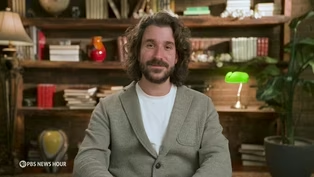
NewA Brief But Spectacular take on building fan-based movements
Video has Closed Captions
Adam Met's Brief But Spectacular take on building fan-based movements (3m 22s)
 New
NewCan NATO allies deliver on promises to increase spending?
Video has Closed Captions
Can NATO allies deliver on promises to increase military spending? (5m 58s)
 New
NewNews Wrap: Funeral held for Iran's late Supreme Leader
Video has Closed Captions
News Wrap: Funeral held for Iran's late Supreme Leader (6m 37s)
 New
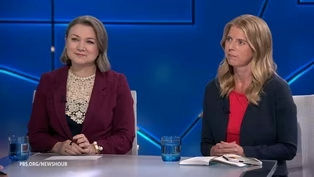
NewTamara Keith and Carrie Dann on calls for Platner to exit
Video has Closed Captions
Tamara Keith and Carrie Dann on Platner facing calls to drop out of Maine Senate race (8m 24s)
 New
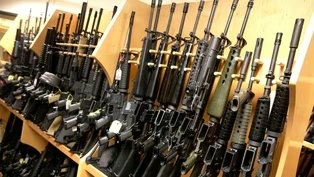
NewTrump administration takes steps to roll back gun rules
Video has Closed Captions
Trump administration takes major steps to roll back gun regulations (6m 14s)
 New
NewU.S. star's suspension lifted after Trump calls FIFA head
Video has Closed Captions
U.S. World Cup star's suspension lifted after Trump's call to FIFA president (6m 46s)
 New
NewWhat to know as ticks spread and bring new threats
Video has Closed Captions
What to know as ticks spread to new regions and bring new threats (6m 47s)
 New
NewWho could benefit the most from Trump Accounts
Video has Closed Captions
Who could benefit the most from Trump's investment accounts for children (8m 43s)
Providing Support for PBS.org
Learn Moreabout PBS online sponsorship
- News and Public Affairs

Today's top journalists discuss Washington's current political events and public affairs.

- News and Public Affairs

FRONTLINE is investigative journalism that questions, explains and changes our world.
 New Episode
 New Episode
 New Episode


Support for PBS provided by:
Major corporate funding for the PBS News Hour is provided by BDO, BNSF, Consumer Cellular, American Cruise Lines, and Raymond James. Funding for the PBS NewsHour Weekend is provided by...