
June 18, 2026 - Full Show
6/18/2026 | 26m 51sVideo has Closed Captions
Watch the June 18, 2026, full episode of "Chicago Tonight."
We’re live at the Obama Presidential Center on the city’s South Side to bring you full coverage of today’s opening ceremony.
Problems playing video? | Closed Captioning Feedback
Problems playing video? | Closed Captioning Feedback
Chicago Tonight is a local public television program presented by WTTW
WTTW video streaming support provided by members and sponsors.
June 18, 2026 - Full Show
6/18/2026 | 26m 51sVideo has Closed Captions
We’re live at the Obama Presidential Center on the city’s South Side to bring you full coverage of today’s opening ceremony.
Problems playing video? | Closed Captioning Feedback
Where to Watch Chicago Tonight
Chicago Tonight is available to stream on pbs.org and the PBS app.

WTTW News Explains
In this Emmy Award-winning series, WTTW News tackles your questions — big and small — about life in the Chicago area. Our video animations guide you through local government, city history, public utilities and everything in between.Providing Support for PBS.org
Learn Moreabout PBS online sponsorship>> Hello and thanks for joining us for Chicago tonight.
Opening Day in Jackson Park.
Brandis Friedman and we're live outside the Obama presidential center bringing you all of the coverage on the city's south side.
Full coverage today of the opening Day ceremonies for the Obama center 5 years in the making.
Here's what looking at.
>> was here.
And the sun.
The city of broad shoulders.
What I found, what I was looking for.
>> A star-studded opening ceremony in Jackson Park today with President Obama paying heartfelt homage to his life in the city of Chicago.
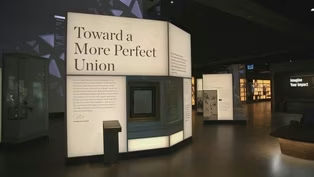
Then we go inside the Obama Center museum to see what's in store for visitors ready to relive the Obama years and look forward to the future.
sense of pride.
Delight.
>> That it's located here on the south side of Chicago.
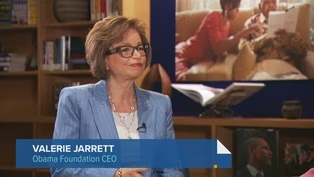
>> We talk with Obama Foundation CEO Valerie Jarrett about what she thinks the center means to the city.
Architecture section.
>> Design from the inside out because it's your interior to building.
We spend our lives.
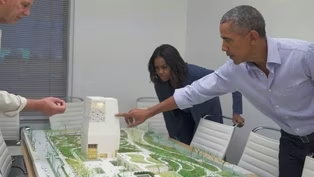
>> And Jeffrey Bear sits down with the Obama center architects to hear how it all took shape.
But first, a look at the events here at the Obama presidential center this morning and early afternoon, all of 4 living former presidents, world leaders and its star-studded musical lineup joined in on the South Side party.
>> Performers include the Roots, Christina Aguilera's, Stevie Wonder, and Bruce Springsteen and Chicago's own Jennifer Hudson and Common.
There are also a number of speakers leading up to the man of the hour.
Former President Barack Obama, of course, including former first lady Michelle Obama.
She told the crowd she had some bragging to do about her husband.
>> You were on flammable at every turn.
Always focused.
Always comb.
Always looking at the long view.
>> There are a couple of moments when the former president became emotional listening to his wife.
He later told the crowd that he had no idea what she was planning to say because she wouldn't let him see her speech beforehand.
Meanwhile, the former president recounted his move to Chicago in 1985.
And its influence on his life.
And it was >> And the The city of broad shoulders.
But I found what I was looking for.
I found my purpose.
It I-45 my baby.
And I found my community.
Friendships that will last a lifetime.
I found a girl from the South side.
Well, it's been my greatest blessing.
>> He also talked about the values that he learned as a community organizer and how he carried those into the presidency.
>> I was possessed.
With this abiding faith.
That if we could give people more of a say in the forces that govern their lives.
If we could bridge some of the differences that drove us apart.
Then we could build an America where everyone counts.
These are the values.
traditions.
I believe And they are not Republican or Democratic values.
American values.
We can all share regardless of party values.
Every president here today different as we are, has tried our best to uphold.
>> And for those who weren't right here at the center, thousands gathered at Midway Plaisance Park just west of the Obama presidential center for a public watch party.
Many attendees came from the South side and neighborhoods where Obama worked as a community organizer.
They say they were thrilled to celebrate the opening of the 19 Acre Presidential Center.
The crowd danced and sang along with the musical performances.
Looking much like the excited crowds of the Obama campaign trail.
Our Joint Hernandez spoke with several attendees about what the day means to them.
>> It was important for me to be here because, of our memorable battle before he was a senator for a president.
And my husband told me that he was going to president that they think the president and have appealed and growth 53 like >> Our to the march on Washington.
In 1962, I was 18 years old.
So this is a full moment moment for me.
>> Historic moment for me.
>> And up next, we'll go right inside the Obama presidential Center museum.
That's coming up right after this.
>> Chicago tonight is made possible in part by the Alexander and John Nichols family.
The Pope Brothers Foundation.
And the support of these donors.
>> Now there's been lots of talk about the exterior design of the museum.
And we're going to get to that in just a few minutes, of course.
But it's also what's on the inside that counts, right?
So far, only a handful of people have gotten to see the exhibits, the artifacts, the installations that are inside the Obama Presidential Center Museum.
And now that includes you, too.
>> From the moment you set foot in the John Lewis Plaza.
You know this isn't your ordinary presidential museum.
Outside.
You're immediately greeted by the Obamas sort of I didn't stop to chat I wanted to see what was inside upon entering the first museum floor.
You're face-to-face with history.
President Obama really wanted to ensure that the story that we told was embedded in nuance, contextual history.
>> That we lifting up and illustrating the idea of on whose shoulders we Museum Director Louise Bernard says creating this experience with the Obamas.
He was a journey to Alice people coming to the museum and they begin that any kind of rooted in this historical storytelling.
Storytelling tracing from the Declaration of Independence to women's suffrage to workers rights and beyond.
>> Progress is never lynnea its exhibits.
Ag says the push and pull.
>> After the first floor of the museum has a laser focus on the Obamas.
Each floor capturing a moment in time.
Some heavier like the aftermath of the Great Recession and the journey to pass the Affordable Care Act and some that are sure to be proud.
Favorites.
>> And level fall.
The people's house about the life of the Obama White House.
We have a full-scale replica, the Obama Oval Office and on level 4.
You can also see some of Michelle Obama's iconic dresses.
You see how she's transformative, intense connection to fashion and style engaging with a wide range of typhus design is whether fashion politics or miniature moments from their White House years.
You get a flavor of their time at 1600, Pennsylvania, according to Michael Stroud Mannus, the Obama Foundation's chief corporate affairs officer this place really gives people an opportunity who weren't around.
Then go back in time and experience what that moment was like.
I found it inspiring.
I think our visitors are going to find that inspiring, >> Well, this is a place where you can comfortable, right?
You You can touch it.
You can.
>> He says he wants the center to feel like an extension of the community come have fun.
>> Plan the playground shoots some hoops, have a picnic.
>> think it's wonderful because now the young adults and the young kids will have the opportunity to.
Be able to come place that can be familiar to them, something they can relate to.
>> I also want people to ask themselves at some point like, well, what's my what's my role in all of this?
It's about democracy.
It's about civic engagement.
And that is a participatory sport.
>> As we both walked and we're both like blowing up with tears and just had smiles plastered on our faces, like feeling inspired in a moment where we can really use >> Does the BDA that they had?
It brought tears to my eyes.
remember, I remember those days when I was so proud to be an American.
I think it gives us hope.
It reminds as we have the ability to really change things, use our voices and actually create the change that we want.
>> They did a good job.
Looks looks like supposed to.
>> While the entire opc team says they're proud of what they've created, they acknowledge there are some things that are missing.
The one thing which library is that answer.
I think answer was goal.
Good afternoon, everybody.
Unfortunately, the worry giving away.
So we've got a picture of it.
But but the 10 students south.
>> Somebody out there has got Thank you very >> Now Michael Stoute man is says that the museum is still taking donations.
So if anyone out there happens to know that tan suit is McCall K. Up next, one on one with Obama Foundation CEO Valerie Jarrett.
>> Reflecting the people and perspectives that make a buck This story is part of Chicago tonight.
Black Voice.
>> Valerie Jarrett was the senior adviser to President Obama for the entirety of his 2 terms in the White House.
That also made her the longest serving senior adviser in presidential history.
Now she is the CEO of the Obama Foundation and obviously a key player in the creation of the center.
We sat down with her to talk about the enormity of taking on this task.
>> how are you What I am a great welcome the Obama.
>> Presidential center.
I waited a long time to say that.
>> You have.
How does it feel to finally be here after it's been a long road?
It has been a very long and arduous road feel spectacular.
What does it mean for the library to be?
On the South side, both for the library and also for the community that it's I think it's a real gift to the community.
I think that it will allow us to put a spotlight on the South side.
And that's deeply personal to me.
As you know.
>> I grew up here, rode my bike, the Jackson Park and hung out at the point in the Museum Science and Industry.
And also saw that the Sir always kept infusion of capital that deserved compared to the North side and downtown.
And so to now see this major economic engine that will drive investment, not just here, but in the surrounding community as well as being kind of beacon of hope for the world at a time when I think we sorely need that.
That's one of the other comments I've gotten from people who visited is the sense of and renewed sense of hope of hopefulness, which is hard, sometimes.
But quite palpable.
When you walk through the museum.
>> So we are also currently in the newest branch of the Chicago Public Library.
Why did the president want to have a Chicago Public Library on site?
>> Well, a literature for young children is something that's always been very important to both president and Michelle Obama and so have a Chicago public library so that the young people, particularly in the surrounding community >> could come and enjoy this beautiful facility.
Then she ran to the presidential reading room where we're sitting now and see the kinds of books bay favor sparked their interest in literature is something really important to them?
>> to be clear, presidential libraries, of course, the typically house, the paper, the archives from from the president's term.
You all decided to digitize them so that they are accessible everywhere and leave that paper actually in the National Archives.
Correct?
So President Thomas, the first digital president and we have the capability to digitize now.
That's not something that was available to former presidents.
And so he wanted to not take up all that space with pay for.
And in fact, at this library is where the original location of the paper was going to go before we decided to invest in the digitization.
And so, yes, the original papers will be help elsewhere.
But everybody, they come here or live on the other side of the world will be able to go online soon and see all of his papers.
And so we've able to put this space to better use, OK?
So speaking of space is across the campus.
There's the forum next door.
There's Cafe Auditorium Media Suite home court with the NBA regulation size basketball courts and event spaces, the fruit and vegetable garden.
>> You mentioned the playground and what will be its the great lawn right now where folks can sled in the winter.
28 commissioned art installations.
Do you think you left anything out?
>> Well, we'll the public thinks that we should do.
Other things will look at that, particularly when it comes to the programming, how we use the space is going to be something that changes over time.
And I look forward, for example, to >> movies on the Great Lawn and watching activities with our young people and getting them engaged, not just in sports, but in good sportsmanship fan, learning Open their eyes to things that they never thought about before often say it's hard to be what you can't say where you come here.
You're gonna be able to infinite possibilities.
already the young people who've come through, I saw a couple boys going into the Oval Office and sitting behind the desk just imagining that they would be president.
Something that may not occur to them.
But for visit to the Oval Office.
>> I'm sure that you are very familiar with and may be attached to lots of different exhibits and pieces of the campus.
But are there any that are particularly personal you know, remind you of any particular memory or memories of your time with the Obamas.
All very personal since I was there for all 8 years, you can believe that.
But I will say one that I think says a lot about his presidency is.
>> Called 10 letters a day.
So every day during the years President Biden was in office.
His correspondents team selected 10 letters of the nearly 40,000 that he received every single day.
And so they look for a representative sampling of those letters and would send up 10 to his home.
And so in the evening when he was working, he would take a break and he would be the letters and respond to them.
Handwritten notes back and then next to the 10 letters and we have 10 letters that are framed is a video with a narration of.
Beating the letters and him responding to the letters at the end.
It was his way of staying in touch with the American people and sometimes being president can be isolating.
If you let it.
And we did a lot did a lot of different efforts to engage people and bring them into the White House so he could hear the stories of the American people 2 out to just get those 10 letters every single day and believe me, some of them a very complimentary.
Some of them are not.
Some of them are people who change their mind based events and some of them were people who have very strong wanted to express an to him.
So, you know, as we've discussed, getting here, took a while.
There's pushback from the community over concerns around gentrification, pushing out longtime residents.
>> Just recently, a report from the Illinois Answers Project Show that a number of initiatives the included in its anti displacement ordinance for Woodlawn residents that either weren't properly managed are funded.
That's yielding little protection, right?
So the median sale price for single-family home has ballooned up 4.6 times the price.
It was 10 years ago when the library was announced was there more that the foundation could have done?
Do you think with the city or with the community?
>> Look, I think we did our part really well.
Number one designing designing the campus talking to the community and hearing what they wanted to see present here.
>> Reaching out to make sure the contractors from the community to the work.
We hired nearly 5,000 construction workers.
Those of people who came for only from the south and West sides.
So we created jobs.
We have permanent jobs.
Nearly 500 of the foundation as a whole 2.50 will be campus.
We recruited from the community.
So as an economic engine, the 850 million dollars that we spent and the people who worked to this campus whose names will be on a wall worker wall that we have created here in the center.
That's our part in doing what we can do.
We work closely with the alderman.
We work closely with them on South, a terrific organization that's working on planning ways in which we can market from here for shops and restaurants in the surrounding community.
We're going to work closely with the Museum of Science Industry to market together.
We want people not just come visit our campus.
We want them to see all of the tools on the south side of Chicago.
And we are hopeful that this capital investment, he's going to help spur additional job opportunities and stores and businesses in this community.
That's our part.
That's us doing the best of what we can do.
But some critics also observed sort of the growth of presidential libraries has sort of shifting to become monuments to the former president or an opportunity for the former president, whoever he may be.
>> And to sort of rewrite some of that history in the president's favor.
What do you say to that how do you see the intent?
The function of a presidential library?
Will this presidential campus is not intended to be a monument to President Obama.
>> It begins with the people upon whose shoulders he stands with Declaration of Independence.
The suffrage movement, slavery.
Reconstruction, civil rights movement.
All of the different efforts by ordinary people to bring about change change that made his presidency pass.
And so we tell that story.
Then we do tell the story of this presidency that we tell the story not simply what went well, but also well, we were unsuccessfully trying to be very honest and open about that so that people can learn from 7 presidents before President Obama tried to pass legislation to improve our health care system.
We were successful, but because in large part, those efforts pave the way.
And so we're hopeful for where we fell short.
We are paving the way for future efforts.
And so this is really designed.
Not to look backwards.
Except for the purpose of helping move forward and all of our programs designed to help young people predominantly develop the kind of leadership skills that they need to pick up that the time and do their part and letters on the outside of new sound which which from President Obama speech on the 50th anniversary of the walk across the Edmund Pettus Bridge.
It's titled We Are America and it challenges all of us pick up that glorious task of improving our nation.
And so that's the future.
That's what we really intend at this campus to be.
And a piece of it is a presidential museum, but it is so much more.
>> And up next, Obama center architects peak with our own Jeffrey Bear about their vision for this new Southside destination.
At the end of his presidency, architects around the world grass.
One single question who wants to design the New Obama presidential center on the South side of Chicago?
Well, 140 firms applied, but only one got to the gig W T Tw is Jeffrey Blair sat down with the architects to discuss the creativity that would change the skyline on the South side.
>> He wanted to be a living place with lots of energy all of the interest that he had as a young man as a president rather than mausoleum.
He was a very interesting client, very knowledgeable client.
>> Tod Williams and Billie TN of Tw B Tas or the architect who won the bid for the Obama presidential center.
A process that took months to secure and included a one-on-one meeting with then President Obama in the Oval Office.
It was.
>> You know, certainly thrilling, but also.
slightly terrifying.
>> You know, though.
>> Bowl of apples you always see in pictures.
>> took an Apple and I kept it for a really, really long And you've taken.
that thing so no was a special app.
>> There would be plenty more apples where that came from because the architects landed the bid thanks to their campus designed that was neighborhood inclusive, a non-negotiable for the Obamas.
>> This is a bomb was very involved in emphasizing the importance of this being a place for families and for people to come and feel a sense of joy.
She was very much about the site and how it's going to be used by the people of Chicago.
>> This is a parent.
When you look at the campus from above the winding trails, lead you everywhere from a basketball court to a sledding hill to a library to the most prominent piece of the 19.3 acre campus.
The eight-story museum building.
>> So this does not look like any other presidential library right?
>> you and that was the intention.
>> The 225 Foot Museum with a shape inspired by 4 hands coming together, had several design changes over the years, including the facade, which was originally set to be marble.
But Chicago contractors knew that material wouldn't stand up to our extreme seasonal weather changes.
>> They're saying no way.
Are we gonna put our names to a building that's made out of marble.
>> So Williams and pivoted to granite specifically tapestry granite from New Hampshire with its marble like swirls.
>> was very intriguing to us and fact that it changes so much so when it rains comes very dark and moody, but then it dries out very quickly and become sort of a little bit more pink.
>> The striking exterior has come under some harsh criticism being called cold for boating, even monolithic.
But the architect to explain that the form follows function.
>> judge people, but what they look like and we need to understand we have to go deeper to get to the real person.
So that's the way we are.
I can actually quite happy that we're not trying to present the whole person on the outside.
>> The museum exhibits required windowless rooms.
>> Because of the artifacts and because lighting because the creation of a sense of drama.
So want bright so that's that was a sort of done deal.
>> Up top the building is wrapped in 5 foot letters from Barack Obama's.
You are America's speech which marked the 50th anniversary of the march from Selma to Montgomery.
And that's where the windowless exterior gives way to light.
Up here in the Nelson Mandela Sky Room on the 8th floor.
You look through the words of Barack Obama and a view of Chicago.
That's not normally celebrated instead of the skyscrapers downtown, you see a sweeping vista of the West side and also the Southside Place.
Michelle and Barack Obama call home.
The architects intended the words to be read only in fragments from below.
>> to some extent, we realize that.
The creation of the top of the building often a perfectly discernible to people who are in the land blow.
So we realized it needed to.
at the top.
>> Presidential center CEO Valerie Jarrett says that looking through the words from the top, almost like being inside the mind of President Obama who called the speech one of his most meaningful mock as it quote, Best captures what America should be more.
The court sentiment.
Williams and Hope their new campus will foster for the future.
>> think the best of this building to come to come and it's going to come.
We be on own lives.
Maybe 200 years maybe 500.
I hope >> For Chicago tonight.
I'm Jeffrey, there.
>> And if you haven't heard already the Obama center, of course, it opens tomorrow, though, at last check.
Tickets are sold out through the fall, OK?
That's our show for this Thursday night.
I'm Brandis Friedman and for everyone here at Chicago tonight.
Thank you for watching.
Stay healthy and safe and be sure to join us for night at 5.37, for the week in review.
>> Closed captioning is made possible by Robert a cliff and Clifford law offices, Chicago, personal injury and wrongful death that serves the needs of
 New
NewGeoffrey Baer Explores the Obama Presidential Center Architecture
Video has Closed Captions
Architects Tod Williams and Billie Tsien explain how it all took shape. (5m 10s)
 New
NewTake a Look Inside the Obama Presidential Center
Video has Closed Captions
WTTW News visited the center for a firsthand look at the exhibits, installations and more. (4m 35s)
 New
NewValerie Jarrett on the Obama Presidential Center, Growing Up on the South Side
Video has Closed Captions
Valerie Jarrett was a senior advisor to President Barack Obama for the entirety of both his terms. (9m 48s)
Providing Support for PBS.org
Learn Moreabout PBS online sponsorship New Episode
- News and Public Affairs

Top journalists deliver compelling original analysis of the hour's headlines.

- News and Public Affairs

Today's top journalists discuss Washington's current political events and public affairs.



 New Episode


 New Episode
 New Episode
 New Episode
Support for PBS provided by:
Chicago Tonight is a local public television program presented by WTTW
WTTW video streaming support provided by members and sponsors.