
Mideast analysts on Iran’s leadership after Larijani's death
Clip: 3/17/2026 | 7m 20sVideo has Closed Captions
Mideast analysts on Iran’s leadership after Larijani's death
For perspective on Israel's killing of one of Iran’s most senior leaders, Ali Larijani, and the head of Iran's Basij internal security force, Amna Nawaz spoke with Alan Eyre and Joel Rayburn. Eyre was part of the Obama administration's negotiating team for the nuclear deal with Iran and is now at the Middle East Institute. Rayburn is a retired Army colonel and is now at the Hudson Institute.
Problems playing video? | Closed Captioning Feedback
Problems playing video? | Closed Captioning Feedback
Major corporate funding for the PBS News Hour is provided by BDO, BNSF, Consumer Cellular, American Cruise Lines, and Raymond James. Funding for the PBS NewsHour Weekend is provided by...
Mideast analysts on Iran’s leadership after Larijani's death
Clip: 3/17/2026 | 7m 20sVideo has Closed Captions
For perspective on Israel's killing of one of Iran’s most senior leaders, Ali Larijani, and the head of Iran's Basij internal security force, Amna Nawaz spoke with Alan Eyre and Joel Rayburn. Eyre was part of the Obama administration's negotiating team for the nuclear deal with Iran and is now at the Middle East Institute. Rayburn is a retired Army colonel and is now at the Hudson Institute.
Problems playing video? | Closed Captioning Feedback
How to Watch PBS News Hour
PBS News Hour is available to stream on pbs.org and the free PBS App, available on iPhone, Apple TV, Android TV, Android smartphones, Amazon Fire TV, Amazon Fire Tablet, Roku, Samsung Smart TV, and Vizio.
Providing Support for PBS.org
Learn Moreabout PBS online sponsorshipAMNA NAWAZ: And we return now to the Israeli killing of one of Iran's most senior leaders, Ali Larijani, and their killing of the head of Iran's Basij internal security force.
For that, we get two views.
Alan Eyre had a four-decade career in U.S.
government, including in the Foreign Service, focusing on Iran.
He's now at the Middle East Institute.
And retired Colonel Joel Rayburn had a 26-year career in the Army.
During the first Trump administration, he was on the National Security Council staff focusing on Iran in the Middle East.
He's now a senior fellow at the Hudson Institute.
Welcome back to you both.
Alan, I will begin with you.
The killing of Ali Larijani, how significant is it?
What does it change?
ALAN EYRE, Middle East Institute: It's pretty significant.
He was the most important civilian leader right now in Iran, alongside the head of the Parliament Speaker Ghalibaf.
So it's important, and it's quite possible he will be replaced by someone more hard-line.
But what's supposed to be important above and beyond what the individual is up, down, living, and dead are the institutions.
And here's what hasn't changed.
The Islamic Revolutionary Guard Corps and the Beit-e Rahbari, which is the administrative exoskeleton that the late Ayatollah Khamenei created.
They're still in the driver's seat.
So Larijani's dead, but his power never came from popular appeal.
He was handpicked by the elites.
They will pick someone else and Iranian policy will by and large continue in the current war footing.
AMNA NAWAZ: Joel, this idea that Larijani's killing means a more extremist replacement for him, a more hard-line replacement, and makes the regime more intractable, harder to deal with, do you agree with that?
COL.
JOEL RAYBURN (RET.
), Former Trump National Security Council Staff: Well, they're already pretty intractable.
I don't know how any -- how much more intractable they can become is marginal.
And I think Ali Larijani represented continuity from Ali Khamenei's policy, his national security policy, his hostility to the United States and the surrounding region.
He was also one of the main people, as Alan pointed out, directing the Iranian war effort.
So, I mean, he's a valid legitimate military target.
And I don't think you can worry about the personalities inside that ruling coterie when you're doing that kind of targeting.
You have to go after the enemy chain of command if you're in the position of the United States and Israel.
So that's what was done.
I think actually, though, where I would disagree with Alan somewhat is, leadership does matter.
Ali Larijani has been there in that leadership team for more than a decade.
I mean, he's had a very senior role going back multiple decades.
So there is -- institutions may be strong or they may be brittle.
There is in the Iranian regime a precedent that leadership, if it's eliminated, can lead to a drop-off.
Look at the removal of Qasem Soleimani.
The Quds Force, the Iranian Quds Force has never been the same since the taking out of Qasem Soleimani, replacing by Esmail Qaani.
There was a -- there's a degradation in their capabilities, their effectiveness and their coherence.
So, yes, institutions matter, but leadership, individual leadership matters just as much, I think.
AMNA NAWAZ: Is the regime less capable, less competent without Larijani?
Could that lead to regime change?
ALAN EYRE: Well, certainly less competent.
Joel's quite right.
There's collective expertise.
Larijani had a lot of it.
What's interesting about him, though, is, for example, he was on the outs politically as recently as 2025.
He was barred from running for president by the elites in 2021 and 2024.
So he's had an up-and-down career.
But you're quite right.
There's a degradation of function here.
Will that increase the chances of regime change?
I don't think so.
I don't think that's a logical corollary to the fact that he's been killed by the Israelis.
I think it's just more likely that this regime will continue on its war footing and sort of stumble along, and whoever replaces him might not be as competent, but will follow the same general lines.
AMNA NAWAZ: Joel, what have you seen that leads you to believe that the killing of Larijani and other senior leaders could lead to regime change, when the next person in line basically steps up to replace them each and every time?
Revolutionary Guard Corps has tens of thousands of people ready to step up and keep replacing anyone killed.
COL.
JOEL RAYBURN (RET.
): Well, if leaders are eliminated and new ones step up and they're eliminated, eventually, there's a deterrent to the leadership.
I don't think they're all suicidal.
I don't think they're all seeking martyrdom.
At some point, there's pragmatism that sets in.
And there is a pragmatic element to the Iranian regime over time.
They can be deterred over time.
I mean, the law of gravity does apply to the Iranian regime.
And it is, I think, in the process of kicking in as their military capabilities are getting close to nil.
AMNA NAWAZ: When you look at their military capabilities, Alan, the way they are still fighting this war, you have talked about Iran having a sort of mosaic defense.
Explain that to us and why it's working for them.
ALAN EYRE: Well, it's not how else well it's working.
They're still getting pummeled by the U.S.
and Israel.
But the mosaic doctrine was born of long experience.
It started after the Iran-Iraq War.
And it's basically decentralizing command-and-control to much lower-levels, so if you decapitate the leadership, you can still have lower-levels acting on their own autonomously, perhaps with prearranged or prewritten orders.
And that's what's working for Iran right now.
So Israel is pursuing a decapitation strategy.
But all that's done, and it's significant, in addition to degrading sort of the collective expertise, is pushing decisions down and out.
AMNA NAWAZ: So if the plan is to operate in this decentralized way, what does that mean for how the U.S.
and Israel wage this war?
And does it stretch the timeline, I mean, that an unpopular war here in the U.S.
that's causing oil prices to go up could stretch even longer?
COL.
JOEL RAYBURN (RET.
): Well, I don't think you can mount a coherent strategic defense when your decentralized elements can't cross-coordinate, they can't mount a synchronized defense, synchronized operations, and their capabilities are distributed.
You just wind up with a bunch of, over time -- you may in the first few volleys have a significant response.
That petered out after the first couple of days.
And now there are essentially isolated elements that can't communicate with one another.
If they're pressured in one place, they can't come to one another's assistance and so on.
I mean, in an operational sense, a strategic sense, the Iranian regime is essentially defenseless right now.
AMNA NAWAZ: In the few seconds I have left, if the regime does collapse, Alan, what takes its place?
Is the U.S.
better off with whatever replaces it?
ALAN EYRE: Well, if it collapses, you have a collapsed state, you have a failed state.
The law of entropy works one way.
You don't collapse into something as complex or more complex.
So a failed state doesn't lead to a new, different, better, more pro-Western, more user-friendly regime.
It leads to a failed state.
And we have seen in the Middle East lots of examples of failed states and what happens.
AMNA NAWAZ: I will give you the final word here, Joel.
Your response?
COL.
JOEL RAYBURN (RET.
): Well, you can have a failed state Iran that is not a threat to the surrounding region, or you can have a kind of Iran that Ali Khamenei built, which was quasi-thriving, using its resources to pose a threat to the region and international security.
AMNA NAWAZ: Colonel Joel Rayburn, Alan Eyre, great to see you both.
Thank you.
ALAN EYRE: Thank you.

Artists use creativity in protesting immigration crackdown
Video has Closed Captions
Chicago artists channel creativity into protesting the immigration crackdown (7m 27s)

LA port chief on how the Iran war is impacting global trade
Video has Closed Captions
LA port chief on how the Iran war is impacting global trade (5m 8s)

A look at Mullin’s rise from MMA fighter to MAGA warrior
Video has Closed Captions
A look at Mullin’s rise from MMA fighter to MAGA warrior and DHS nomination (6m 8s)

News Wrap: Cuba slowly restoring power after blackout
Video has Closed Captions
News Wrap: Cuba slowly restoring power as Rubio calls for new leadership (5m 24s)
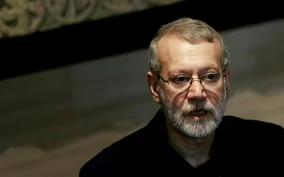
Strikes kill Iranian officials in another blow to leadership
Video has Closed Captions
Strikes kill high-level Iranian officials in another blow to country's leadership (4m 48s)

Venezuela’s historic run meets USA in WBC final
Video has Closed Captions
Venezuela’s historic run meets USA in World Baseball Classic final (7m 6s)
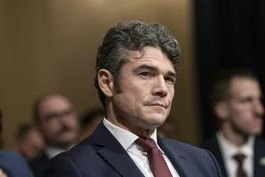
What Kent’s resignation says about U.S. intelligence
Video has Closed Captions
What Joe Kent’s resignation says about U.S. intelligence and counterterrorism efforts (5m 49s)

Who is Joe Kent, the U.S. official who quit over Iran war?
Video has Closed Captions
Who is Joe Kent, the counterterrorism official who resigned over the Iran war? (2m 15s)
Providing Support for PBS.org
Learn Moreabout PBS online sponsorship
- News and Public Affairs

FRONTLINE is investigative journalism that questions, explains and changes our world.

- News and Public Affairs

Amanpour and Company features conversations with leaders and decision makers.












Support for PBS provided by:
Major corporate funding for the PBS News Hour is provided by BDO, BNSF, Consumer Cellular, American Cruise Lines, and Raymond James. Funding for the PBS NewsHour Weekend is provided by...