John McGivern’s Main Streets
St. Joseph, Michigan
Season 5 Episode 4 | 26m 48sVideo has Closed Captions
St. Joseph and Benton Harbor are Michigan’s close-knit sister cities.
St. Joseph and Benton Harbor, Michigan share a close sister-city bond. St. Joseph charms with a pristine beach and a quaint main street of local shops. Benton Harbor brings a scrappy, creative spirit, with vibrant arts and great food. Together, they offer the whole package!
Problems playing video? | Closed Captioning Feedback
Problems playing video? | Closed Captioning Feedback
John McGivern’s Main Streets is a local public television program presented by PBS Wisconsin
John McGivern’s Main Streets
St. Joseph, Michigan
Season 5 Episode 4 | 26m 48sVideo has Closed Captions
St. Joseph and Benton Harbor, Michigan share a close sister-city bond. St. Joseph charms with a pristine beach and a quaint main street of local shops. Benton Harbor brings a scrappy, creative spirit, with vibrant arts and great food. Together, they offer the whole package!
Problems playing video? | Closed Captioning Feedback
How to Watch John McGivern’s Main Streets
John McGivern’s Main Streets is available to stream on pbs.org and the free PBS App, available on iPhone, Apple TV, Android TV, Android smartphones, Amazon Fire TV, Amazon Fire Tablet, Roku, Samsung Smart TV, and Vizio.
Providing Support for PBS.org
Learn Moreabout PBS online sponsorship- John McGivern: We're in the Twin Cities of Michigan!
[bright music] - Announcer: Thanks to our underwriters.
- There's no place like Oconomowoc.
Explore, play, shop, stay!
Visit Oconomowoc!
- Together, doing good for 130 years.
Horicon Bank: It's the natural choice for community banking.
- My father taught me that to make great bakery, you have to do it the right way.
O&H Danish Bakery, where kringle traditions begin.
- Support for this program provided by Plum Media.
From first spark to final edit, it's all about bringing stories to life with purpose and precision.
- Announcer: Financial support has been provided by our friends at Greenfire, a construction management company, the Friends of PBS Wisconsin, and the Friends of Main Streets.
- Announcer 2: Have you listened to our podcasts?
John, Emmy, and the producers talk about what happened behind the scenes and share their favorite things about each community.
Main Streets continues on your favorite podcast platform.
♪ 'Cause these are our Main Streets ♪ ♪ Something 'bout a hometown speaks to me ♪ ♪ There's nowhere else I'd rather be ♪ ♪ The heart and soul of community's right here ♪ ♪ On these Main Streets ♪ - I am in St.
Joseph, Michigan, on the shores of Lake Michigan.
People flock here for the pristine beach and the quaint downtown.
Then they cross the river to discover St.
Joe's sister city, Benton Harbor.
In this episode, we're gonna explore both of them.
I'm about 90 miles from Chicago, about 50 miles from Kalamazoo, on the west side of I-94.
This is St.
Joseph and Benton Harbor, Michigan.
Emmy?
- Emmy Fink: John?
I love a Lake Michigan community.
- Me too.
- I have a question, though.
- Yes.
- How did St.
Joseph get a town in Michigan named after him?
- I have an answer for you.
So, we're going back 300 years ago, when there was a Catholic mission here.
- Hmm.
- Okay, the mission is long gone, but the name, St.
Joseph, they liked it, and it remains.
- And I bet access to this lake had a lot to do with its history.
- Emmy: This port was great for shipping goods out, but bringing tourists in.
So, we're here at Silver Beach.
This was the place back in the day.
There was an amusement park, and then think of all the things: Ferris wheel, a carousel, a boxing ring.
You name it, it was here, and people came.
Now, you can't box at the beach anymore.
- Yeah.
- But we could ride the carousel.
- No.
Let's first talk about Benton Harbor.
- Oh, okay, yes.
Well, Benton Harbor had their fair share of tourists as well.
In the late 1800s, people would come to take the waters.
Does that mean anything to you?
- It does.
- Yeah?
- That's soaking in mineral baths, yes?
- Exactly, yes.
Manufacturing helped to really build up the area too.
In fact, a lot of those spaces are now being turned into, like, really swanky restaurants and shops, lots of fun stuff.
- Sounds like our kind of town.
Or, really, more like our kind of towns.
- Yes, because there's two of them.
- Yeah, so let's go, come on.
- Which way, that way?
Yes, let's go together.
- John: Either way.
- Check out that sign behind me.
It says "I love St.
Joe."
You notice it doesn't say "St.
Joe's."
No, don't say "St.
Joe's" around here.
Someone will hear you, and someone will talk to you, okay?
Emmy's tip: "St.
Joe."
That's all.
[bright music] - John: I'm really excited about this.
This is like a step back in time for me.
We're at the variety store.
This is G&M.
- Matt Bonenfant: Whether it's paper, whether it's batteries, whether it's greeting cards or toys, there's a lot to find in our store.
- John: It's almost everything, isn't it?
- Melanie Bonenfant: Right, and stuff you didn't know you needed.
- John: [chuckles] But you hope that they do, yes?
- Melanie: Right.
- Take a look at this, Brian.
Ford Thunderbird.
Perfect!
Who was raised in this industry?
Either of you?
- We both had history in retail.
- Yeah.
- Melanie: My dad purchased a Murphy store in Indiana.
- So, a Murphy store, for us who don't know, is like a Woolworth's... - Yes.
- ...or a Ben Franklin?
- Yep, and then a few years later, he purchased the St.
Joe store.
We moved here in 2020.
That's when we took over.
- John: From your parents?
- Melanie: Yes, May of 2020.
- Matt: May of 2020.
- Melanie: It truly became a family business during that time.
- John: Yes.
Frisbee.
A summer without a Frisbee is not a summer.
Bread.
Summer of lemonade.
What's it like to have a store like this in a town that is really seasonal?
- Melanie: Everybody's in such a good mood when they come in 'cause they wanna be here and they want to be shopping.
- John: You have kids in this business?
- Our son, Joe, has been working, you know, for about three years with us.
He's gonna be taking over my father-in-law's store in early spring next year.
- I was told that-- and I don't know if you know this yet, but you're taking over the store in Rockville.
- Joe Bonenfant: I am, yes.
- Is Joe ready?
- Yes, I would say he is ready.
- You paused for a moment, though.
[laughter] I saw the pause.
- When it comes down to the business aspect and the leadership aspect, I couldn't ask for anybody better to teach me.
- Going to the beach, yes?
Perfect.
- Well, this is really our puzzle wall.
- John: Yeah.
- Matt: This is one of the largest attractions, I would say, to our store.
- This is a throwback.
- Matt: Yes, it is.
Customers really like the throwback sodas.
- John: And it makes a great display.
- Matt: Oh, it does, yeah.
And it also keeps with the old-time feel, yes.
- I just need one more thing.
Come on.
- Matt: There are people that come in specifically for this cookie.
- We're all set.
Nostalgia-- to walk into your store and feel like, "Oh, I've been here, and I remember what it was like."
- Matt: If you can't find it at G&M, then you don't need it.
- John: Forget it.
[all laugh] - St.
Joseph is definitely not lacking in the lighthouse department 'cause take a look behind me.
There are two of them back there.
They're pretty, aren't they?
But it also serves a purpose.
If you're on a boat out on Lake Michigan, but you're heading towards the river, and you line up those two lights, you knew you were on track.
How smart is that?
Now, you'll find a lot of lighthouses on Lake Michigan, but you won't find too many with its own catwalk.
Now, here's the reason for the catwalk.
It's so that the keeper could get between the lighthouses.
Think about it.
It's pretty dangerous if this pier is covered in snow and ice.
I'd want my own catwalk too.
If you are a lighthouse person, you wanna go for a tour of the inner lighthouse.
You can do that all summer long 'cause this place is a St.
Joe icon.
- John: We are outside this impressive structure.
Let's talk about what this is.
- Brian Carroll: So, this is the Israelite House of David.
It's a religious commune that was founded here in Benton Harbor in 1903 by Benjamin and Mary Purnell, who were religious leaders, actually, from Ohio, and then they moved here.
So, Benjamin was considered to be the seventh and final messenger in a series of seven Christian Israelite leaders.
He was charismatic.
They had a very small following, and in very short order, they built up a large following.
And around the time of World War I, 1918, 1920, they had 1,100 members here.
Then by the '40s, you're down to about 250.
And then that number just kind of dwindles all the way 'til 2020, when the last practitioner of the faith passes away.
It was a busy, bustling place.
Like, this building behind us, we figured at its peak had between 65 and possibly 80 people living in it.
- John: Yikes.
- It was a true commune.
People gave up their earnings, their property, their wealth, and anything they earned after that, they gave to the collective.
And all the needs they had were taken care of from the commune.
There were certain requirements to the religion.
One of them was celibacy, another was vegetarianism.
And they were also pacifists who wouldn't serve in the military.
Well, they would, but in non-combat roles.
- John: Yeah.
- You didn't have a lot of privacy here, and we think some people did leave 'cause they felt like they didn't have any privacy.
- Right, "What are you looking at?!"
- And communal living isn't for everybody.
Let's just say that.
- No.
They had a great baseball team?
- Brian: Yeah, they had a professional barnstorming baseball team that traveled around the U.S.
It was an exhibition team, and people like to say that the House of David was to baseball what the Harlem Globetrotters are to basketball.
- John: They didn't cut their hair?
They didn't shave their beards?
- Brian: The men didn't cut their hair or shave their beards.
That was the signature look.
They became more well-known for their businesses than they did their religion.
- John: Hmm.
- Brian: The baseball team, the amusement park, the farms, the food processing.
They were very entrepreneurial and very successful.
- John: And your job now is to what?
- Brian: My job is to organize all the stuff in here and create the collections of the museum.
- John: Can you share any misconceptions?
- Brian: A lot of people still think there are practitioners of the faith here, but the last one died back in 2020.
This is a typical-size room, two, three, sometimes four to a room, depending on the size.
And there were common rooms to congregate in, so people didn't spend a lot of time in their rooms.
- John: They slept here.
- Brian: Yeah, yeah.
- John: And to somebody who does what you do for a living, is this incredibly exciting?
- Brian: This is a dream job.
- John: Is it really?
- Brian: Down here is our main archival offices.
Lots of boxes like this everywhere containing House of David material.
We deal with, you know, digitizing film.
- John: Yep.
- Brian: Scanning photographs, letters, documents.
Yeah, this is it.
- John: How long before your museum opens?
- Brian: We're looking about three years.
- John: Three years?
- Brian: So, what did you think?
- Incredibly interesting, and a story that I had never heard before, and I'm old, so there.
Thanks so much.
- Brian: You're welcome.
Thanks for coming.
- John: You do a great job.
Back in the early days of St.
Joseph, some residents couldn't pay their taxes.
So, to earn extra money, they went out into the street.
Streets back then were dirt paths, so what did they do on those dirt paths to earn extra money?
- They rolled up their sleeves, and they dug up tree stumps.
That's right.
They were building the roads, so they had to cut down trees.
And if you needed a little help on your taxes, they would give you 25 cents back for every tree stump you dug up.
I mean, it's a lot of work for 25 cents, but you think, back in the day, that was a hefty sum.
I'm really glad they didn't take down this 'cause she's a beauty.
Come here.
- This is an old box factory.
They used to make fancy boxes for fancy stores like Marshall Field's.
After it closed, an artist gave it a splash of color and transformed it into the Box Factory for the Arts.
Nowadays, artists from all over Berrien County come to create.
And this is open to the public to stroll through the galleries and the studios and enjoy events in the performance space.
I call this a perfect reuse of an incredible building.
A great story in Benton Harbor.
This is the Hinkley Block building, built in 1898.
By 1997, it was falling down, this building.
The people who bought it restored this building.
In 2004, they opened this, which is the Water Street Glassworks.
- John and I get to join the Fired Up!
program, which is a teen program, but they get to do this for free.
- John: Learning glass art.
You ready?
- Emmy: Yeah, let's do it.
We have to really pay attention.
- No, I'm going to.
- Okay?
You're gonna teach me the basic of making a bead, yes?
- Gina Edwards: I am.
We are going to light a torch, and we're going to melt the end of this glass rod until it gets molten.
We use a propane and oxygen torch.
- John: Oh, there we go.
- Gina: Okay, so you're gonna just introduce that glass nice and slow by tapping it into the flame.
It's gonna get kind of flippy-floppy.
And that glass is just gonna flow right from the glass rod onto the mandrel.
And that right there is a basic bead.
Not too bad.
- Not too bad, huh?
- Not too bad.
- Not bad.
It's ready to come off.
- Gina: Use some muscles.
- Shut up, lady.
[Gina laughs] - Gina: Once you get the basic steps down and kind of understand the way the glass behaves, it is very Zen.
- How's that look?
- It looks great.
- John: Does it?
- Gina: Yes.
- Finally, my turn.
Kamden is here.
What are we making?
- Kamden White: A two-color twisted paperweight.
It would look something like this one here.
All right, let's go.
So, we're gonna come over here.
I'm gonna hand you a pipe.
- This is heavier than it looks.
- Kamden: The furnace here is called the crucible, and you're gonna dip your pipe in, and then you're gonna drill in and grab your glass.
- Emmy: Oh, got it, so you're, like, just dipping.
- Kamden: Yep, and that's getting your color on both sides.
- Emmy: Oh!
- Kamden: And we're gonna go over to a reheating chamber.
And this runs at about 1,000 degrees.
And I want you to grab your tweezers.
- Yeah, I'm not nervous.
No, I'm not nervous at all.
- Kamden: And then we're gonna roll it towards you, and we're gonna twist the glass.
- Emmy: Oh, wow!
Looks like an ice cream cone!
Okay, so, we're putting more glass on it now?
- Yes, we are.
- Oh, it's getting bigger!
It's getting bigger!
- Kamden: Yeah.
- I feel like this really is meant to be a two-person job.
- Kamden: It is.
That's why we always have an assistant.
- Emmy: This is intense, Kamden, holy cow.
I had no idea how much work this was, how many steps this was.
- Kamden: Yeah, and think about how small this is, and it's so much work.
- It's bigger than John's blue little bead.
That's all I care about, Kamden.
[Kamden laughs] - Kamden: And I want you to tap the pipe as hard as you can.
There we go.
- Ahh!
- Kamden: This is your piece.
It's a paperweight.
- I did it!
Thank you!
- This was great, wasn't it?
- It was so fun.
- I'm glad I did the beads.
- I'm glad I did the paperweight, but it has to slowly cool down.
- John: Mine was instant.
I love instant gratification.
And I can wear mine around my neck.
I'd like to see you wear your paperweight around your neck.
- You know, I'll wear it.
- She'll be like... - Emmy: I just love this market.
And that's exactly what it's called: The Market.
It was a car dealership, then it was a toy store.
But I'm telling you, it was meant to be this little cute market.
The Cheese Lady?
That's my nickname!
The variety of products here at The Market, truly impressive.
The Market has been here since 2021, and so has Chef PJ with Dad's Farm.
All right, I'm gonna do the Baja shrimp burrito.
My favorite time of the day: lunch.
Hurry up, you guys.
I will eat your food.
Look at this little shop!
John warned me about this, too much shopping.
Credit card can't handle this!
- John: We are at Houndstooth restaurant.
This restaurant is talked about all over by everyone.
When did this room open?
- Cheyenne Galbraith: September 13, 2019.
- 2019?
- Yep, exactly.
- Where do we start?
- All right.
Well, we're gonna start with the Japanese milk bread.
It has this really interesting texture that's almost like cotton candy.
- John: Yeah.
- Cheyenne: It's very sweet and savory at the same time.
It's our number-one seller.
- John: It's your number one?
- Cheyenne: Oh, yeah, it's a must-have, so I thought I would show it to you.
This actually was an inspiration during COVID when I was digging deep and trying to remember some of my favorite childhood treats.
And it was always that garlic bread from the freezer department in your grocery store.
- John: Oh, yeah.
- And so, I said, I set out to make the best garlic bread I possibly could.
- John: Why is this called Houndstooth?
- Cheyenne: Yeah, so, Houndstooth is in reference of the black and white checkered pattern that you have to wear on your pants when you're in culinary school.
It's a Scottish plaid pattern.
I have Scottish heritage, and I thought it was a fun way to tie in my heritage and my love of cooking.
- John: Yeah.
- Both: Cheers.
- Thank you.
That's delicious.
Let's keep going!
[Cheyenne laughs] Potato-crusted halibut.
- Cheyenne: Yeah.
It's a white, flaky fish.
It's a very easy fish to eat, it's delicious.
- John: In your mind's eye, in your vision, is this how you saw it looking?
- Cheyenne: I was pleasantly surprised that on day one, it felt like a vibrant, real restaurant.
- John: And a color that looks perfect with it.
- Cheyenne: Right?
- John: Yeah.
It's really special.
- Cheyenne: Thanks.
- John: And we haven't had a bite yet.
Can we share a bite?
- Cheyenne: Yes.
- John: Good.
- Cheyenne: My only rule is that you enjoy.
- John: Wow, this is perfect.
And there we have it.
That's my plate.
- And then I can show you our most popular dessert, our pannacotta.
- John: Talk about your menu.
- Cheyenne: Yeah.
So, the menu is small, and it's meant to be shared.
My style of cooking includes using as many local ingredients as I can.
I kind of just let whatever my growers are excited about drive what I'm excited about.
- John: And so, the menu's seasonal?
- Cheyenne: It is hyper seasonal.
And the seasons force us to learn and to try new things in the very best way.
- Brilliant.
It's great.
Are you the chef every night?
- Cheyenne: I'm here often, but I actually come out and do my best to deliver the dishes to the guests so that I can interact with them and bring the food to your table.
When we can see the joy we bring to people, it drives the creativity and it, you know, makes us wanna come back.
- John: That's great.
You should have your own show.
- Cheyenne: That's the easiest interview I've ever done.
- John: That was easy?
[both laugh] That was great.
In 2024, St.
Joseph unveiled a statue to honor the memory of Martin Luther King Jr.
And so did Benton Harbor.
Here in St.
Joseph is Martin Luther King and two children releasing doves of peace.
In Benton Harbor, it's Martin Luther King around a table, signifying everyone is invited to have a seat at the table.
Two Kings, two cities together.
Imagine this: Back in 1898, there was a guy named Augustus Moore Herring.
Yeah, 1898.
He had an invention that he brought down to this very beach, and he fired it up.
And he may have been the first person ever to... Guess what.
- He was the first person ever to fly a motorized glider for 10 seconds.
- What are you doing here?
This is not how it usually works.
But go ahead.
- Oh, thank you so much.
Now, this was five years before the Wright brothers, so you might be thinking, "Well, why isn't he famous?"
Well, here's why.
His method was a little bit dicey.
You know, he was like, "Ohh, I hope it works!"
Orville and Wilbur, they actually learned how to control their flying machine.
Big difference.
- Yeah, question, answer.
Got it all in one sitting.
- Yeah.
- Love that.
See ya.
- Oh, okay.
- John: We do a lot of manufacturing on the show.
This is where manufacturing and science come together.
The name of the company means what?
- Pete Riethmeier: Yeah, no, LECO stands for Laboratory Equipment Company.
We specialize in science, not in names.
- Right, "This is what we do."
- Pete: LECO actually manufactures laboratory equipment.
We cover a lot of different ways of measuring what's in samples and objects that customers want to know more about.
- What was the first one?
- The first one was our carbon sulfur analyzer for the steel industry.
- And what year was that?
- That was in 1936 that the company was founded.
We had three founders, and they all kind of came together and figured out a way to make a process going from hours long to minutes long.
- John: This is a customer experience building, yes?
- Pete: Yes.
The vision for this building was to give our customers an opportunity to see our instrument in action.
I'm walking you to our technical service lab.
- I am gonna help you?
- Lauren Heirty: Yes, you are.
- We got a little surprise for you.
- You have no idea.
[all laugh] - It's everyone's dream to be a scientist.
Do you want me to kind of walk you through the process?
- Yeah, please, if you don't mind.
- So, we're gonna log this in as a standard.
- Pete: Very few facilities have active labs like we do.
- John: Like, why is that important?
- Pete: So, farmers out there that need to test the quality of their soils.
- John: Yeah.
- Pete: They're sending it in to test it on our equipment.
Companies that are testing how hard steel is, test how brittle it is.
So, we do organic analysis, inorganic analysis, metallography, and mass spectrometry.
No other company does it all like we do.
- Lauren: The magic should happen soon.
- Oh, there it is.
- There, yeah.
See, this one's really cool 'cause you can see it in live time here combusting, which is super fun.
And there you go.
It's done, yeah.
It's kind of like magic, to be honest with you.
-Very good, good.
- Yeah.
- I am way over my head, you guys.
- Ariyona Palmer: This is one of our inert gas fusion instruments.
Just waiting for my TC cell to stabilize.
'Cause we just turned that gas on.
- Oh, if I had a nickel for every time I said that in my life.
[Ariyona laughs] - Ariyona: Did you bring some steel with you?
- John: I did.
There it is, yes?
- Ariyona: Okay, and now we're ready to analyze.
- John: Perfect.
And are these machines manufactured here in St.
Joe?
- Pete: We do virtually everything here in St.
Joseph, Michigan.
- John: This is global?
- Pete: Yeah, we're a global company.
We have 25 subsidiaries.
- John: Hmm.
- Pete: And we service probably 75 countries globally.
- Ariyona: That's our plot for oxygen and nitrogen.
That's your result.
So, that's a 50 ppm oxygen, and we're at 49 almost.
Our instruments are relied on to get the right result, and we take pride in that.
- So, is this a good job for you?
- Yes, it's perfect.
- Is it?
- It's a perfect job.
- Perfect job?
- It's kind of a chemist's dream here.
- John: Is it?
- Ariyona: Yeah.
- John: That was great.
One of the world's largest manufacturers of appliances is Whirlpool.
This is their global headquarters.
They have partnered for an initiative that I can't wait to tell you about.
So, there are people all over the world, they have to wash their clothes by hand, and who does that usually?
Women and girls.
So, there's an organization, The Washing Machine Project, that has invented manual washing machines that do not need electricity.
Whirlpool partnered with this organization.
So, there are volunteers from Whirlpool who assemble these manual washing machines and they distribute them globally.
Goodwill from Michigan all over the world.
- This is the Paw Paw River, and Third Coast Paddling will get you all set up.
They helped me out.
It's super convenient.
It's right near town.
They get everything set.
And, Will, you're gonna push me in, right?
- Will: I will.
- Look at me.
I'm just having a great time on the Paw Paw, where I'm paddling the Paw Paw!
[bright music] - If I said "Happy Poochie" to you, where do you think I am?
It's a restaurant.
Help me.
[both laugh] - Richard Gresens: Well, Happy Poochie is-- Actually, it's a nickname, and it's my wife's nickname.
And it's what our grandson kind of termed her when he was growing up.
- John: When you drive by, though, people presume something else.
- Richard: A lot of people will come by and they say, "Well, we thought it was a gourmet dog food place."
And it's like, "No, no."
It's more about this pooch than it is the other pooches there.
- Right.
How did you start this?
- Richard: So, my background is automotive design, industrial design, and I was working at a place.
They went through a big restructuring.
And we were looking to figure out, "What do we wanna do?"
So, we've been married 25 years, and I've always loved her food, right?
- John: Yeah.
- And so, I love to eat.
So, I knew, if I like that food, a lot of people are gonna like that food.
And we had talked about doing a restaurant.
And we said, "You know what?
Let's just give it a go."
- John: Artwork all over your place.
- Richard: Yes, yes.
- John: I love this artwork.
Where is it from?
- Richard: That's from my wife.
- This is from your wife as well?
- Yeah, as you can see, there's a lot of plants, right?
- John: Yeah, is that your thing?
- That's Lisa's too.
- John: That's hers as well?
- Yeah, that's hers too.
- What do you really do?
Nothing?
- Not much, no.
[both laugh] Thank the Lord Lisa's around.
- Richard: Yes, right.
- Your artwork is great.
All your flowers and your plants.
- Lisa Gresens: You know what, it makes me happy.
- Does it?
- It really does.
It's been my passion.
- Location-wise, we are in Benton Harbor.
- Richard: Benton Harbor proper, yep.
- John: With a great "Food" sign.
- Richard: Yes.
- John: Where'd you get that thing?
- Richard: Well, that was here.
- John: It came with the building?
- Richard: Yes.
- John: Great.
- Richard: I love the Americana.
No, it's definitely kind of a landmark.
- Landmark, yes.
- You get people coming in and just taking pictures of the signs, so it's neat, yeah.
- John: As far as menu concept, is that Poochie's?
- Richard: So, we're a lunch restaurant.
- John: Just lunch?
- Richard: Just lunch.
So, we did the lunchtime concept and it's sandwiches, salads.
We have wraps.
Those are Lisa's recipes, and everything is fresh.
You know, the sandwiches are all made by hand.
- John: So, for you to say, "We're doing lunch only..." - Richard: Mm-hmm.
- Lisa: Yeah, and especially-- - John: ...is really so respectful of yourselves.
- Lisa: You know what, it was, because I said, "I don't wanna work at night or on weekends."
So this worked out fan-- [laughs] - No nights and no mornings, no weekends.
- Yeah, it's good for us.
- Yeah.
- It allows us to have a life outside of here and enjoy things.
It's been the best thing that ever happened to our marriage and to us.
- John: So good, mmm.
It's delicious.
I'm a happy poochie.
[upbeat music] They may be sisters, but these two towns have distinct personalities.
- But the perfect pair of sisters.
- Yeah, I'm glad we met them both.
- ♪ Sisters ♪ - ♪ Sisters ♪ - Both: ♪ There were never such devoted sisters ♪ ♪ There's nowhere else I'd rather be ♪ ♪ The heart and soul of community's right here ♪ - Dirt paths to make... Ohh!
- Sorry, I did-- [blows raspberry] - What are you doing here?!
Boo!
[laughs] - Keep going?
- He is famous!
We have him for Christmas every year.
What I call clueless.
[all laugh] Can I stop?
- Announcer: Thanks to our underwriters.
- There's no place like Oconomowoc.
Explore, play, shop, stay!
Visit Oconomowoc!
- Together, doing good for 130 years.
Horicon Bank: It's the natural choice for community banking.
- My father taught me that to make great bakery, you have to do it the right way.
O&H Danish Bakery, where kringle traditions begin.
- Support for this program provided by Plum Media.
From first spark to final edit, it's all about bringing stories to life with purpose and precision.
- Announcer: Financial support has been provided by our friends at Greenfire, a construction management company, the Friends of PBS Wisconsin, and the Friends of Main Streets.
- Announcer 2: Have you listened to our podcasts?
John, Emmy, and the producers talk about what happened behind the scenes and share their favorite things about each community.
Main Streets continues on your favorite podcast platform.
- John: That'll work.
[Emmy inaudible] It's Gail's new mic system.
- Yeah, it's so great.
- Gail: Whoo!
- John: Can you not face me?
- I don't have a problem with this at all.
Preview - St. Joseph, Michigan
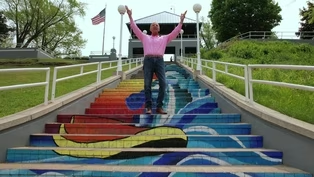
Preview: S5 Ep4 | 29s | St. Joseph and Benton Harbor are Michigan’s close-knit sister cities. (29s)
Providing Support for PBS.org
Learn Moreabout PBS online sponsorship












Support for PBS provided by:
John McGivern’s Main Streets is a local public television program presented by PBS Wisconsin