
Trump faces opposition to war from NATO allies, MAGA base
Clip: 3/20/2026 | 9m 14sVideo has Closed Captions
Trump faces growing opposition to Iran war from NATO allies and his MAGA base
President Trump is angry at NATO and insulting the alliance as “a paper tiger” for not supporting his effort to open the Strait of Hormuz, even as he sends more Marines to possibly do that very job. The panel discusses the global opposition to the U.S.-Israeli conflict with Iran.
Problems playing video? | Closed Captioning Feedback
Problems playing video? | Closed Captioning Feedback
Major funding for “Washington Week with The Atlantic” is provided by Consumer Cellular, Otsuka, Kaiser Permanente, the Yuen Foundation, and the Corporation for Public Broadcasting.
Trump faces opposition to war from NATO allies, MAGA base
Clip: 3/20/2026 | 9m 14sVideo has Closed Captions
President Trump is angry at NATO and insulting the alliance as “a paper tiger” for not supporting his effort to open the Strait of Hormuz, even as he sends more Marines to possibly do that very job. The panel discusses the global opposition to the U.S.-Israeli conflict with Iran.
Problems playing video? | Closed Captioning Feedback
How to Watch Washington Week with The Atlantic
Washington Week with The Atlantic is available to stream on pbs.org and the free PBS App, available on iPhone, Apple TV, Android TV, Android smartphones, Amazon Fire TV, Amazon Fire Tablet, Roku, Samsung Smart TV, and Vizio.
Buy Now
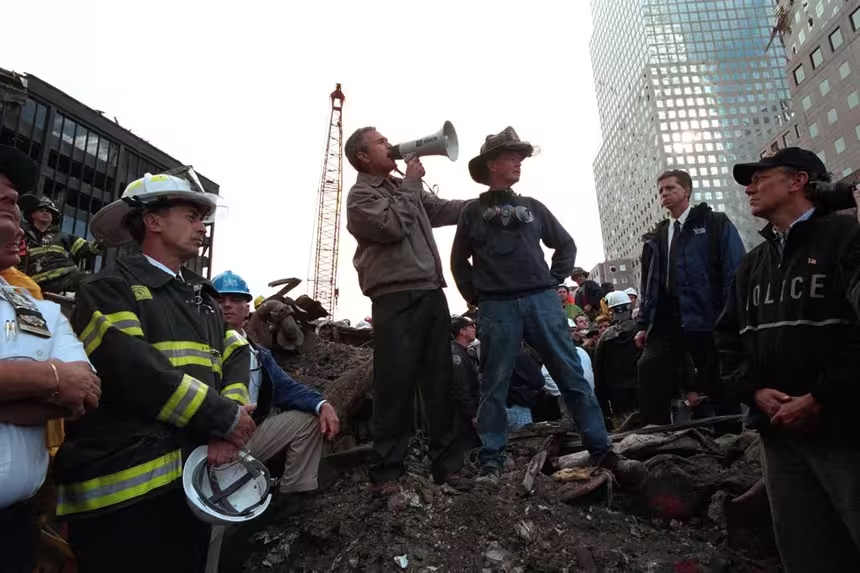
10 big stories Washington Week covered
Washington Week came on the air February 23, 1967. In the 50 years that followed, we covered a lot of history-making events. Read up on 10 of the biggest stories Washington Week covered in its first 50 years.Providing Support for PBS.org
Learn Moreabout PBS online sponsorshipI want to talk about part of the strategic problem is that Donald Trump has alienated some allies.
Um NATO doesn't seem very interested in this.
And I want to I want to play a a a sound bite from Donald Trump because I to me this is probably the most Trump thing that Trump has ever done.
This is in a meeting with the Japanese uh uh this week.
Let's just listen to that.
Why didn't you tell US allies uh in Europe and Asia like Japan about the war before attacking Iran?
So we are very confused about we Japanese citizens.
Well, one thing you don't want to signal too much you know when we go in we went in very hard and we didn't tell anybody about it because we wanted surprise.
Who knows better about surprise than Japan?
Okay.
Why didn't you tell me about Pearl Harbor?
Okay.
Right.
You know, he's asking me, uh, no, you believe in surprise.
I think much more so than us.
And, uh, we had to surprise him.
And we did.
I, you know, I mean, it's it's like I don't know what to I mean, it was a surprise.
That was a surprise.
That was a surprise attack on on on a meeting.
um that that sort of thing obviously makes allies not want to come to the Oval Office much less work in an alliance with I so so the question is are allies right now those who need the straight of hormones open even more than than we do directly um what is the mood in your reporting that you're seeing in terms of uh coming in and helping uh there's definitely concern and there's been a lot of reluctance uh you know NATO allies especially actually um were very reticent to um take part or even um offer any support to the United States military whether it's their bases or you know the Gulf countries didn't want the US in their airspace even in the leadup to this um and so over time they found that they have little choice especially with the economic crunch worsening um they're now you know you have a few nations the UK uh leading the charge um offering escorts through the straits um Gulf countries are now kind of uh putting one foot forward because they have no other choice or countries are being bombarded.
Um and so that's where it stands.
But President Trump is definitely taking notes and and listing names as far as countries that did drag their feet because this is what he's complained about all along.
I think the alliances were so fractured going into this, right?
We had the Greenland issue, uh his closest China to Russia.
So you're going into this crisis with no goodwill and we're seeing that lack of goodwill really play.
So, so the qu one of the questions is how much of the NATO response just not only NATO but the NATO response a reaction a resentment reaction to the way he's treated allies and how much of it is just um we didn't want to invade Iran right now like we're not this is not our game.
Well, a part of it was just the absence of consultation which was the essence of the question.
And by the way, I lived in Japan for six years.
I'm sure I violated many of their rules, but one of them is no Pearl Harbor jokes.
So, you know, I would imagine if you're trying to get something done with with an country that's currently an ally.
Uh but in this particular case, um he could have done what George W. Bush did, which was go around the world and try to build a coalition of the willing and make the case before the military action without telegraphing exactly when he was going to attack.
And that worked some for Bush and didn't work with other places.
But in this case, no one got consulted.
And so now they're being told, well, you're going to come in to go do finish the job for us, and we won't tell you quite what our strategy is for getting out.
And also, even if you help us, the next day I might come back to Greenland.
Yeah.
And start.
I'm I'm laughing because Steve and I covered uh the Bush both Bushes and their efforts to build coalitions in the Middle East and and as you were talking, Steve is kind of laughing over there.
The idea of Donald Trump going around the world and building alliances is No, it's it's inconceivable.
I mean, look, how many times in the past two weeks have we heard him say, "We don't need them.
We can do it on our own.
We don't care.
Oh, we need them.
They'd be smart to do it."
I mean, it's just change.
Look, if it's about trust, goodwill, and common interests, we don't have any trust.
And there's good reason they don't trust us.
There was reporting this week that the Danes were sending uniform military from allied countries to Greenland in anticipation of a possible US invasion of of Greenland.
They were doing this for a reason because Donald Trump had continuously said that that was on the on the table or refused to take it off the table.
Goodwill, as Udri says, he didn't build goodwill.
He's gone out of his way to insult our allies, particularly in Europe.
Now, we're at the point where there are some common interests and they've got to now look out for their interests, however much they must be, they must be frustrated about the comments that he's made in the way that he's sort of given the back of the There was one incident in particular where he recently um suggested that allies didn't do enough to support the US in Afghanistan and that offended allies around that offended among others the Danesfully died in combat.
Uh Steve, stay on this this uh point about uh dissension and in and alliance building.
He's having a little bit trouble even in MAGA world building support for this, not just the Joe Kent issue, but there there there's there's not a lot of uh overenthusiasm.
Am I wrong in saying that?
Yeah.
I mean, I would make the distinction between sort of MAGA rank and file who have flipped.
They were skeptical of this war when it started.
Donald Trump said he's for it.
He's talked about why we needed to do it and they're now for it overwhelmingly.
If you look at sort of MAGA influencer world, the Tucker Carlson, Megan Kelly uh set, they have been they started, I would say, skeptical and suggested that this would be a betrayal of America first.
When they say that Israel is manipulating him, they're saying that Israel is manipulating him.
I mean, they're sort of now at the point where they're making every argument they possibly can, but you know, really, who's the fool here?
that they thought that they expected consistency from Donald Trump that he thought that they that they thought that he believed these things that he said that he had a worldview.
This is a personalist foreign policy.
I want to go to another related issue which is Cuba.
Uh because the lazy Susan is going to come around again, I think, and it's going to be Cuba.
Um he has uh talked about taking Cuba.
He talked about it this week.
Uh Vivian, you've been studying this problem for a while.
Do do you think that he's actually going to kind of pull a Venezuela with Cuba in the coming months?
Yes.
Okay.
Uh while while we are all looking over here in the Middle East, the wheels are very much in motion for a Venezuela style operation in Cuba that would potentially potentially result in regime change.
Now, they are leaving the door open to a negotiated settlement.
They've been very public about that.
President Miguel Diaz Canal of Venice of Cuba um came out this week and acknowledged for the first time publicly that he is talking to the administration.
So there So the pressure has worked in that sense.
It has worked, but whether or not that means he gets to keep his job that remains to be seen.
I assume by the way that success or failure in Iran will very much determine whether there's appetite for uh hemispheric adventure.
Yeah, I agree.
I mean like he's had successes, right?
Venezuela and Iran in June was a success.
This might be his first major military failure potentially, right?
And if that fails, how do you do regime change in Cuba?
It's it's tough.
Um David, in in our last minute, I want to turn to a subject that that actually affects all of us.
Uh judge just ruled that the Pentagon is violating the First Amendment rights of uh of the press by banning by banning uh members of the Pentagon press corps.
We've all been in the Pentagon press corp at one time or another.
Idris is currently in it.
uh uh tell me about that decision and what it means for the press and the first amendment.
Well, you know, this was critically important because what was going on here essentially was a test of the question of can you have a free society without a free press.
We had a government that wanted to control the press corps within the Pentagon and the judge's ruling is sweeping in its wording.
Uh it's a great reminder of what an editor of mine uh Bill Keller uh former executive editor of the Times once said which uh I think goes very well for this which is there's a reason the First Amendment is first and this opinion drove that home and told the Pentagon give them their passes back.
Well Adric, it looks like you're going to have to put on a suit and tie again and go back to work.
We're going to have to leave it there.
We'll be back on this subject of course, but thanks to our guest for for joining me.
 New
NewWhat does winning a war with unclear objectives look like?
Video has Closed Captions
What does winning a war with unclear objectives look like? (14m 13s)
Providing Support for PBS.org
Learn Moreabout PBS online sponsorship
- News and Public Affairs

Top journalists deliver compelling original analysis of the hour's headlines.

- News and Public Affairs

FRONTLINE is investigative journalism that questions, explains and changes our world.











Support for PBS provided by:
Major funding for “Washington Week with The Atlantic” is provided by Consumer Cellular, Otsuka, Kaiser Permanente, the Yuen Foundation, and the Corporation for Public Broadcasting.