
Wired For Connection
6/1/2026 | 56m 5sVideo has Closed Captions
Scientists now link friendship to a remarkable range of benefits—both physical and mental.
Scientists now link friendship to a remarkable range of benefits—both physical and mental: lower blood pressure, stronger immunity, reduced dementia risk, better sleep, and longer life. But technology and the pace of contemporary life threaten our ability to connect. Cutting-edge science reveals how isolation can harm us, while meaningful relationships can heal.
Problems playing video? | Closed Captioning Feedback
Problems playing video? | Closed Captioning Feedback
Wired For Connection
6/1/2026 | 56m 5sVideo has Closed Captions
Scientists now link friendship to a remarkable range of benefits—both physical and mental: lower blood pressure, stronger immunity, reduced dementia risk, better sleep, and longer life. But technology and the pace of contemporary life threaten our ability to connect. Cutting-edge science reveals how isolation can harm us, while meaningful relationships can heal.
Problems playing video? | Closed Captioning Feedback
Where to Watch Wired For Connection
Wired For Connection is available to stream on pbs.org and the PBS app.
Providing Support for PBS.org
Learn Moreabout PBS online sponsorship♪♪ -In an increasingly busy and distracted society, it's easier than ever to neglect one of our most basic needs: connecting with each other.
-Social connection is essential to who we are.
We are a social species.
We are happiest when we're most connected.
-It is a fundamental human need and experience to feel belonging and having community.
-Social connection is not just an important part of our lives.
It's the heartbeat of our existence.
-We've learned from really robust studies that people who have more friends, stronger connections with other people live longer, healthier, happier lives.
-When this vital need for connection isn't being met, the consequences can be life-threatening.
-We are biologically wired to expect social connection.
Being alone outside of the group can elicit all sorts of physiological responses.
-People who are lonely and socially isolated fall at increased risk for a wide variety of chronic diseases.
-Social isolation, loneliness have a significant impact on longevity.
They shorten your life span.
-Loneliness actually is a greater risk factor for premature mortality than is smoking 15 cigarettes a day.
-Around the world, public health officials have begun raising awareness about the health impacts of loneliness.
-61% of young people suffer from serious loneliness and 36% of the population overall.
So loneliness is a huge crisis.
-What happens to us when our basic need for connection goes unmet?
And why is this so important?
Especially now?
"Wired for Connection."
♪♪ -Social connection is one of the most miraculous and beautiful features of the natural world.
We humans do something that's extraordinary and almost unique.
We form long-term non-reproductive unions with unrelated individuals.
Namely, we have friends.
-You can't separate who we are as conscious beings from the fact that we're social.
We evolved to be social.
If this is core to who we are and we're not getting it, there's bound to be some sort of dysfunction at the physical or mental level.
-But if connection is essential to our well-being, why aren't we more aware of the health impacts of loneliness?
-There is a lot of skepticism out there on the impacts of loneliness.
In part, I think it's the fact that, for so long, this has been viewed as a very personal kind of experience.
-Loneliness is subjective, and so, for a long time, we thought that this important criterion would preclude our ability to study it, but it doesn't.
-The observation that people who are less socially connected get sicker more often and don't live as long.
If I talk to colleagues of mine who are sociologists, they'll say, "Yeah, we've known that for like 100 years or more."
-From epidemiology to anthropology, different scientific disciplines have measured this in slightly different ways.
We see a converging of evidence.
[ Laughter ] No matter how you measure it, when social connection is high, we tend to see more protective kinds of effects.
And when it is low, we tend to see more negative kinds of consequences.
-To begin to understand our need for connection, we start with our fellow primates.
-So, you can see vultures in the very top of the tree, but down lower, you can see the silhouettes of some baboons.
-Humans share over 90% of our DNA with other primates.
-Social connection is in our DNA, quite literally, and it's in our brains and it's in the brains of our primate cousins.
Monkeys have the same social brain network in their heads wired up in the same way.
-This week, everyone was supposed to look... -For more than five decades, anthropologists have been studying baboons in the Amboseli ecosystem of Southern Kenya, one of the longest-running studies of primates in the world.
-Baboons are pretty closely related to us.
They are these large-bodied terrestrial animals that evolved mostly in sub-Saharan Africa that live in social groups.
-Baboons live about three times as fast as we do, and that means that over the course of one human researcher's lifespan, we can capture many generations of baboons, four, five, six, or more.
-Yesterday, there were one, two, three, four... -When you have long-term data, you get to a rich understanding of how the events at one phase of life affect another phase of life.
The main way we measure social connection is through looking at grooming relationships.
If you watch one animal grooming the other, they're very detailed in the way they'll move the fur up and look for ticks and pieces of dirt and clean the fur.
But the social role of grooming is equally important.
-Grooming is what monkeys want to do most of the time.
That's the equivalent of us going to get a coffee or a beer with friends.
-We watch what they're doing, and then we use molecular methods to ask what's happening simultaneously in their blood cells.
Then we extract DNA or RNA and get readouts that allow us to say, "Well, in this individual who is really socially isolated, we get a lot of activity in this part of the genome.
And in this individual who is quite socially integrated, we see something different."
-The baboons that are more socially connected have longer lives.
We've also been able to demonstrate that baboons who have a lot of adversity in early life live shorter adult lives.
-But what happens when an entire group of monkeys faces a catastrophic challenge?
In 2017, Hurricane Maria ravaged the habitat of a colony of rhesus macaques in Puerto Rico.
-They lost fresh-water systems, fresh food.
It just devastated the vegetation.
But what happened was amazing.
The monkeys immediately after the storm became more social.
And this is kind of shocking because you might think when your environment is destroyed, you're going to fight over every last scrap.
And that's not what we saw.
-One hypothesis is that, without adequate tree cover, shade was scarce... and the macaques needed to cooperate to find it, becoming more tolerant and less aggressive.
-Remarkably, we've found that that persists to this day, so now, years later, the monkeys are still friendlier.
They still invest in these social relationships.
-That adaptation mirrors human behavior.
Our innate drive for connection is made clear in disasters and crisis situations.
-Social connection is kind of a basic human need, the same way as thirst and hunger are human needs.
...talking to Isaiah, not me... -Dani Dumitriu is a neuroscientist and pediatrician at Columbia University, where she studies social connection in infants.
-Our hypothesis for all the work in my lab is that human connection is something that gets hardwired into the brain very, very early in life.
Babies are born wired to connect.
In my lab, we think zero to 3 months of life are really the critical period for that social connection to happen.
And if it doesn't happen within that time span, then children will not be able to, as adolescents and into adulthood, have normal social functioning.
-From birth, our biology compels us to connect, fueled by oxytocin, a powerful hormone that helps us form our earliest bonds.
-Oxytocin is this peptide hormone.
It's released during childbirth.
It's released during nursing.
And it seems designed to really build that connection.
-One way oxytocin is released is by simple touch.
-We come pre-wired to depend on touch as a very primitive primordial channel for driving connection.
There are sensors in the skin, the hairy parts of the skin, like on your forearms or on the back of your head, that project to parts of the brain that's kind of giving you this oxytocin rush.
♪♪ -Children can overcome early lack of social connection only if they start getting it within that critical period of development, so generally thought of the zero to 3 years.
-How exactly are children able to overcome the lack of social connection?
The brain can be rewired during development because of plasticity, the unique ability of the brain to change.
-The essence of the brain is plasticity.
That is how the brain works.
It's a learning machine.
-The first couple years of life is the time that there's the highest plasticity in the brain.
Over the course of the first two years, the brain actually doubles in size.
So during the first couple years of life, there's so many connections that are forming, and that plasticity means that if a child falls behind in those first few years, it is very, very easy to get them back on course with proper intervention.
We record brain and heart rate... In my lab, we work on emotional connection and emotional synchrony, which is the flow of how the mom and baby come together.
Now, this sounds intuitive, but there's still no standardized training for any medical doctor into how to evaluate relationships.
[ Laughter ] The biggest goal of my work is to understand how social connection becomes developmentally embedded and helps support strategies that promote that development in order to prevent loneliness.
And on a large scale, that can actually have societal impact.
-Yeah.
Ohh.
-While social connection is essential for early childhood development, our own awareness of it really comes into play during adolescence.
-As most people can relate, adolescence can be a challenging time socially, so it's perhaps not surprising that we see loneliness rates are highest among our adolescents.
-One reason adolescence is so challenging is that the brain is still developing during this period.
The amygdala, a key brain structure involved in processing emotions like fear, pleasure, and aggression is highly active in teenagers.
But the prefrontal cortex, which regulates decision making, impulse control, and reasoning, is still developing and won't fully mature until the mid-20s.
-So you have this period where there's a little bit more reactivity to things motivated by fear, by anxiety, by pleasure, without the counterbalance of the more rational prefrontal cortex.
-This unique stage of brain development complicates the many social challenges that teenagers face... ...such as social anxiety and isolation.
-We're studying more and more how things like social isolation and loneliness are related to health outcomes throughout life.
And what we see is that when kids experience social isolation, they're more likely to have worse health in their adulthood, and, additionally, they're more likely to have risk factors like higher blood pressure or higher cholesterol.
-As if adolescence isn't difficult enough... the teenage generation faced additional challenges during the COVID-19 lockdown.
-Across the country, at least 21 million kids now home from school.
-We saw a lot of teenagers struggling during that time and seeing their access to teachers and support systems cut off and positive peer relationships cut off.
When you know how strongly social isolation and loneliness are related to mental health, it's no surprise that a lot of people experienced these symptoms during the pandemic.
-The lockdown also accelerated the rising impact of technology on human relationships... for young people, above all.
-There is a linear relationship between the amount of social media consumed by teenagers and worse mental-health outcomes.
The more they use it, the worse the outcomes.
♪♪ -If teens use social media more than three hours a day, they'll have double the risk of depression, they'll have way increased risk of social anxiety and social avoidance.
And that means less real-life relationships and connection.
-The definition of loneliness is the discrepancy between our desired level of connection and our actual level of connection.
So this comparison can be magnified when we are on social media.
We may see others living what appears to be a full social life.
Ours, in comparison, may not look as full.
-Social media is notoriously a place where misinformation, envy, hate speech, and bullying are prevalent.
-Social media is doing harm to our kids.
-The government of Australia is so concerned that it has even banned it for children under 16.
-The first of its kind anywhere in the world.
♪♪ -The social-media ecosystem is a very unpredictable, hostile, unsafe place, extremely unsafe.
It's much easier to keep the eyeballs on apps by pumping images of fear and threat and insecurity and hate into people's visual and audio fields.
You don't even have to have human beings consciously do it.
The algorithm will do it for you.
-There are definitely cases of suicides that have been affiliated with bullying on social media.
For kids in general, being on social media all the time usually means a withdrawal from in-person connections.
-When I'm scrolling, I'm just forgetting and just avoiding everything else in my life.
-Kids get less and less used to talking to real-life people they don't know, and so they become more and more avoidant and anxious about real-life connections.
And what we're seeing with social media is an increase in loneliness.
-I see social media as an incredibly low bandwidth connection between people.
And so when we accept social media as a substitute for connection or community or accept the emoji as a substitute for real emotion, we're settling for something and we're giving up what we really know about connection.
And that's an enormous loss.
-Technology has gotten between us, right?
We spend all this time on screens, and we don't spend time together.
During adolescence, we are forming the connections in our brains that allow us to navigate adulthood.
Now imagine you've kind of shifted the course of that.
You know, you walk past a restaurant, and you'll see two young people at a table.
They look like they might be on a date.
And they're on their phones, you know, the entire time.
-The dominance of social media complicates an already difficult situation for teens, who face consequential decisions.
[ Man speaking indistinctly ] ♪♪ -As we step into adulthood, the complexities of work and greater responsibilities increasingly challenge our capacity to maintain deep connections.
-Suddenly, coming out of the academic world and getting into the workplace and, actually, feeling quite afraid, I think that's probably what a lot of young people feel.
Suddenly you're in these adult-to-adult connections.
You are expected to know the answers to things.
You're expected to suddenly know how to be productive.
And when I was in the workplace in the beginning, I think I felt really alone.
-Sharon Aneja is a consultant who helps businesses foster social connection on the job.
-According to a recent Gallup survey, 1 in 5 people report feeling lonely in the workplace.
We've got e-mail.
We've got phones.
We've got video calls.
We've never been more supposedly connected.
Yet, so many people report feeling lonely.
And a lot of that comes down to the culture.
We have sacrificed connection for productivity.
Hi!
-Sharon discovered the importance of social connection in a deeply personal way.
♪♪ She was a hard-driving executive whose pursuit of success ultimately ruined her health.
-I think that we live in a society and in a culture where actually it's permissible to be addicted to your work.
The more productive you are, the more of value you are to an organization.
And I think I really inhabited that mindset, and I really pushed myself.
Having personal relationships really was very much secondary.
And as I was getting more and more stressed, my immunity was definitely getting compromised to the point where I needed medical interventions.
And because I had pushed and pushed myself in that relentless pursuit of achievement where I had pushed people away, I felt really alone.
I felt very isolated.
I didn't know who to turn to.
-Making matters worse for young professionals like Sharon, there are powerful social stigmas around loneliness that often deter people from seeking help.
-Stigma is something that we really think about with loneliness measurement because it can be hard to identify as feeling lonely.
There's a lot of shame attached to the concepts of lacking companionship or feeling isolated.
-And beyond that, our bodies have a physical reaction to isolation.
-Every human being knows you kind of feel good when you're in the company of your friends.
You have that kind of warm feeling.
Your heart rate drops.
It feels great.
That's an evolved physiologic response.
Conversely, when we lack friends, we experience that as very threatening and we have a different kind of physiologic response, which can actually harm our bodies.
-The brain's mechanism for dealing with stressors, including isolation, is called the sympathetic nervous system... or "fight or flight" reflex.
-There are hormones that are released in our body that trigger in our mind that something is off.
-When you encounter a stressor, the brain tells the adrenal glands to release the hormones cortisol and adrenaline, which work together to increase your blood pressure and heart rate.
This stress response gives us heightened alertness and increased energy in order to handle a short-term danger.
-Your brain is bracing itself for injury.
Your cardiovascular system pumps blood a little bit faster because it thinks you may need to deliver more oxygen to your muscles to run or fight.
Almost every organ system of the body receives some kind of message from this "fight or flight" neurobiology.
-Your body has stopped directing so much energy towards reproductive function and digestive function.
And that's an appropriate response, but it's not a good response to be in on a regular basis.
-The "fight or flight" stress response was built basically for a different world than the one that we live in.
-In a prehistoric world, life was a constant battle against deadly threats.
And without the protection of a tribe, survival would be even more precarious.
-If you see a lion, it is really good for that cortisol and that adrenaline to just be flooding your body.
You run out of there, right?
But if that continues in your body with things like loneliness as well as other stressors, that ultimately does the opposite thing to the body.
It overwhelms the body.
-When people are exposed to chronic stress, the body releases cortisol at higher levels than it should.
And when we're exposed to cortisol for that long, that can affect our cardiovascular health.
It can affect our brain health.
It can affect the immune system.
-We live today very differently than those hunters and gatherers did.
We've created a culture where everybody feels chronically insecure.
It's great for economic productivity.
Like, insecure people, they work really hard.
But if you're running that kind of "fight or flight" biology as a lifestyle, it's just gonna eat your body.
♪♪ -Anything else come to mind?
-By starting her own company, Sharon found a way to share the lessons she learned with others.
[ Laughter ] -For workplace consultants like myself, we're talking to organizations about how we can maintain that culture of success but without burning people out... ...ensuring that we're not pushing people to the point where they're in endless meetings and they have no ability to connect with anyone else.
[ Laughs ] Yeah.
♪♪ -But what happens when people are no longer going into the office?
The unprecedented events of the pandemic made connecting even harder.
-Prior to the pandemic, I had to go into my office every day, but I saw my colleagues there, and then suddenly we were not allowed to come to the office.
-While we are spending a lot more time on video calls, that doesn't mean that we are necessarily better connected to the people on those calls.
-When we have Zoom meetings, what's cut out, except for that first 30 seconds while we're waiting for everybody to get on, is small talk, which precedes and follows every meeting of human beings.
These things are very important.
-These technologies that helped us cope with isolation became really comfortable, really convenient.
Because of those kinds of advantages, the very tools that helped us cope with isolation are now reinforcing isolation.
-What happened during the pandemic and the move to remote work and all the changes in our lives wrought by COVID-19, we have not begun to understand, and I think it's affected us in many ways we haven't yet reckoned with.
-Not only is social connection at work good for our health, studies have shown that it is beneficial for team dynamics in the workplace.
At the University of Pennsylvania's Wharton School of Business, Michael Platt explores the phenomenon of synchrony in which brain activity and physiological states align among two or more people.
-So what we're looking at here is a very simple study collecting data from two human participants here.
One is eye tracking.
And then the other piece of data we get from these headbands is electroencephalography data, so these are brainwaves.
We're trying to get a measure of synchronization amongst people who might be in an audience.
Synchrony is a biomarker of connection, and when it's higher, it means you're likely to work better together.
And so we've been trying to understand what is the impact of synchrony in terms of group outcomes, team dynamics.
And are there any ways to turn it up, take it to 11?
That small increment in performance could be the difference.
In one of our earliest studies, we worked with the Penn rowing team.
Rowing depends on synchronized movement.
And so we had these four-person boats, and we studied them in their dryland training.
While they were on these rowing machines lined up next to each other, we measured brain activity, heart-rate activity.
And what we found is they were able to achieve some brain synchrony that would later predict good collaboration, good teamwork.
So this was a kind of breakout moment for us.
We take those insights about how we're wired to connect with each other into business settings.
We've been able to measure brain activity in people while they're working with each other, and we've found amazing patterns of activity at work that predict social connection.
So if you're more synchronized, you are more likely to cooperate, the communication's better, higher trust, et cetera.
-The importance of social connection becomes more clear as we reach our senior years.
As younger family members move away, retirement ends relationships at work, and peers and friends die, opportunities for social connection become fewer and fewer.
But surprisingly, many seniors don't show higher incidence of social disconnection.
-The evidence actually shows that older adults tend to be among the most active people in our communities.
You know, some of the highest rates of volunteering, community participation, religious participation.
I think the challenge is when people don't have opportunities to do what they want to.
-When those opportunities aren't there, negative health outcomes tend to arise.
-What we found was that people who reported any degree of loneliness had a greater likelihood of losing their independence, having more difficulty with everyday tasks, and they had a greater likelihood of dying over a six-year period.
The specific outcomes we see in older adults are greater risk of dying from a heart attack, worse control of diabetes, developing dementia, specifically Alzheimer's, risks of frailty, getting weaker, increased mortality.
It's literally everything that you can think about.
-For Steve Cole, the connection between loneliness and chronic diseases became clear when studying the HIV crisis in the 1990s.
-One of the things we figured out early in the context of HIV infection is that your social life mattered.
For instance, gay men who were in the closet got sick and died 30% faster than the guys who were out of the closet.
So there's something about how you live your life that was getting into the body and changing the way the virus was working.
And when we looked at the "fight or flight" biology of these folks, that's exactly what they found.
Their nervous systems were just running this constant low-grade stress factory in their body.
♪♪ -Cole's research centered on norepinephrine, a neurotransmitter that enables this "fight or flight" response.
-We could do simple little experiments where we take some HIV virus, put it on some white blood cells, some immune cells, in a test tube, and then just add some norepinephrine in there as if these cells had just been exposed to "fight or flight" stress biology.
It turns out the virus replicates somewhere between 3 and 5 times as fast in that scenario.
-Cole expanded his research to find out if the stress of loneliness and social isolation could be driving other diseases, as well.
-We went systematically through all of the genes to help us understand what was going on in lonely people getting sick with these chronic diseases.
We could localize what might be operating differently in the immune cells of a lonely person versus a non-lonely person.
-We've been able to find that genes that are activated in people who are lonely look very systematically different.
-Honestly, it was the easiest data analysis I have ever seen in my entire life because it was just so clear what had happened.
If you took all of the genes in the genome and you found the ones that were most overactive in the white blood cells of lonely people, they were all involved in inflammation.
-Different inflammatory markers are associated with different medical conditions, with cardiovascular disease, with an increased risk of dementia, with diabetes.
You name it, there is a medical condition that inflammation will affect.
That is part of the reason why loneliness is so pernicious.
-If your body was running this kind of molecular program of more inflammation and less antiviral response, yeah, you're going to get exactly the diseases that lonely people get.
-Despite growing research revealing the severe health risks of loneliness, the medical community has often shown skepticism and overlooked the problem.
-Before the pandemic, when I would talk to clinicians about loneliness or social connection, I would receive a lot of skeptical looks.
It's like, "Is this really my job to be talking about loneliness?"
These are not concepts that we're trained in in medical school.
-...massive randomized controlled trial... -Thanks in part to the pandemic, slowly but steadily, the longtime skepticism around social connection is beginning to dissolve.
-The pandemic started to destigmatize some loneliness and isolation because it was so rampant and because we were all isolated.
-People recognized that there is a pain to being isolated, to feeling alone.
And it came home to them.
They felt it.
Or they know what it feels like to their mother who's in a nursing home and nobody's allowed to go in and visit with her.
That's pretty real.
-I think since the pandemic, it's been a much easier sell that loneliness and isolation are problems that affect our health and our well-being.
[ Siren wails ] Not only were clinicians seeing this among their patients every day, but many clinicians were feeling that themselves.
It really took a lot of the stigma away attached to loneliness because it suddenly became this open conversation that our entire society was having.
-Um, we sent it... -Some scientists are taking action to address the crisis through organizations such as the Foundation for Social Connection, which aims to improve social connection in society through evidence-based strategies.
I think now we've moved to a place where, "Okay, what do I do about it?"
What I want to do is start a work-in-progress... -Yes!
-...campus-wide.
And so our approach now has been, how do we integrate these assessments into health systems in ways that are not burdensome to clinicians?
-We as a research community are coming together to try to have a consensus and bring some scientific standards to some of the interventions that are being proposed.
[ Chatter ] -There is no one solution to loneliness.
People feel lonely for different reasons and in different ways and at different points in their lives.
And at each juncture and in each circumstance, an intervention will have to differ.
-Health officials and organizations around the world have begun to address loneliness and social isolation as a public health issue.
Here in the U.S., one of the boldest initiatives has been in San Mateo County in Northern California.
-Today, a Bay Area county became the first in the nation to declare loneliness a public health crisis.
-David Canepa is president of the county's Board of Supervisors, who introduced the resolution.
-I want to make sure that that person who's suffering alone, wherever it is, that we provide them with connectivity.
If someone is feeling lonely, we have a responsibility to make sure that we connect them with resources.
-San Mateo declaring loneliness a public health emergency was a really critical step.
This is not one isolated person.
It's me.
It's you.
It's your neighbor.
It's all of us that are at risk and may experience this at some point.
It's a recognition that this affects the health, well-being, and, ultimately, finances of an entire county.
-San Mateo's efforts build on long-standing organizations like San Francisco's Curry Senior Center, where researchers like Perissinotto and Kotwal consult on how its programs can better alleviate loneliness.
-So I just kind of want to check in with you and see how you're doing.
-So, Curry serves as this amazing hub for the community where people can come there and have a lot of their different needs met.
One of their underlying principles is to address social isolation and build community.
-This is what I love about community organizations.
They're in the weeds.
They're in the community.
They see what's actually going on.
Community organizations are living and breathing this every day.
-How about you, Alfonso?
-At Curry, one of the simplest and most popular programs is known as the Lunch Bunch.
-Welcome to Lunch Bunch... -Lunch Bunch has been around for 30 years to provide a place for social support for seniors.
Many of the members have been in San Francisco about 30 or 40 years.
And then along came old age, so that kind of pushed people further into isolation.
So we provide them a means to come together, and I think it's a fabulous social support network for them.
-Mark Pisarcik is a Curry Center member who has been caring for his ailing husband.
-Outside of our relationship, we only have a few close friends and acquaintances, so I needed to get myself out to be prepared for the future.
♪♪ To be able to go with this group and laugh and enjoy it for a short period of time each week is just great for me.
It has helped me so much.
-That sounds fun.
You have a busy weekend.
-As we journey through life meeting new people, what turns a simple encounter into a lasting connection?
-We're really interested in learning about what predicts, who's going to become friends with whom, who's going to become really socially connected.
Yeah... -Carolyn Parkinson is the director of UCLA's Computational Social Neuroscience Lab, where she explores how the human brain processes social relationships.
In one of her studies, Parkinson scans the brains of multiple members of peer groups with fMRI and tracks the data over time.
-Essentially, people will just be laying down in the scanner, and they'll see on a screen projected above their face a series of video clips.
We can look at pairs of participants and look at the similarities in those temporal trajectories of how their brains are responding to what they're seeing.
So, here we scanned people before they met one another, and we see that the neural similarity that's measured is much greater among people who wound up becoming friends.
So we see that people who are going to become friends in the future seem to respond to the world around them in ways that are really similar to one another.
The people who go on to become friends in the long term have really synchronous neural responses to each other.
♪♪ -We may be wired to connect with some people more than others, but the impacts of those connections are far-reaching.
-I'm enjoying this heat.
I don't know about you guys.
-Scientists have found that having something to live for, like attending a weekly lunch with a group of friends, can provide some powerful health benefits.
[ Laughter ] -We've actually spent a number of years looking at this molecular biology in loneliness intervention that change this underlying biological risk.
Interestingly enough, there is something that does work, and that is a sense of meaning and purpose in a person's life.
-Having a strong sense of purpose in life is probably the most important psychological predictor of longevity.
When negative stuff happens, our ability to recover is so important, and it turns out that people who have their eye on something really meaningful, the stresses and strains of life become less significant.
-Purpose overcomes "fight or flight."
People who have a high sense of meaning in their life, a sense of engagement with an important mission or a community, their bodies look great at the molecular level.
♪♪ -Having a strong sense of purpose is really, in part, about connection, because we often have a purpose in benefiting others, in being able to care for others, in loving others, and that is an intimate component of purpose.
-Once we realized how powerful purpose was as an antagonist of threat and insecurity, we started looking for protocols for making more purpose and meaning in everyday life.
And one of the projects that has been most successful is an intervention called Generation Exchange.
-Generation Exchange places retired seniors into public schools in South Central LA as teachers' aides.
-Do you always have time to eat breakfast?
-No.
-These mentors get a sense of purpose and connection from the program, which produces measurable health benefits.
Steve Cole collaborates with the program, analyzing blood samples from participants to understand its impact as a life-changing intervention.
Once they get trained and go into the classrooms, the level of inflammatory biology drops dramatically and antiviral biology goes up by more than any other intervention that we've ever seen.
-Discovering a sense of purpose is just one way to counteract loneliness.
Science has shown that meditation can create more possibilities for connection.
-How meditation influences the structure of the brain is a very important question that has only in the last decade been seriously investigated by modern science.
♪♪ -Richard Davidson has been studying the effects of meditation on the brain and nervous system for over 30 years.
This has included studying esteemed practitioners such as the Buddhist master Yongey Mingyur Rinpoche.
-Mingyur Rinpoche came to our lab for the first time in 2002, and we probed him in so many different ways over the course of roughly a week of testing.
-The first time, I went to his laboratory, and he put me in fMRI, in a huge machine.
[ Laughs ] And it has a huge tongue coming out, and I have to lie down as like crops.
-We recorded baseline EEG, brain electrical activity, baseline fMRI, and we saw how the brain changes with meditation practice.
Meditation does alter the functioning of the prefrontal cortex and the way in which it's connected to the amygdala and to other brain regions.
And through those changes, it can modulate the activity so that we can harness the power of the prefrontal cortex.
-How is this possible?
Because of our brain's plasticity, contemplative practices can effectively retrain our brain to be less reactive to stressors, thus alleviating social anxiety.
♪♪ -The idea that we can train our mind is, I think, still foreign to many, many people because we are living in a world today where our minds are being constantly bombarded with information from outside.
And the research shows that if we engage in intentional exercise to strengthen specific pathways in the brain, we can be the drivers of our own brains much more than is typical in our society today.
♪♪ -Through meditation, you are in charge of your transformation in your brain.
It's almost like we become our boss.
[ Laughs ] -But the benefits of meditation are not limited to the individual's well-being.
When stress levels drop, the brain shifts from a reactive state to one more open to empathy and understanding of others.
-There are types of contemplative practice that are specifically targeting social connection.
These are practices to cultivate kindness toward others, compassion toward others.
These are really simple practices, and they really help to increase our social connectedness.
-Meditation is within, almost like discovering your basic innate goodness.
So, everybody has this wonderful nature.
If you understand yourself more, you can understand others more.
-While meditation may reduce social anxiety, innovative new research offers the potential for more targeted treatments.
-When I started trying to find the neural basis for things like craving or anxiety or loneliness, a lot of my colleagues told me that this was career suicide and that this isn't something that you can study in neuroscience, but technology is changing.
There's a lot of capacity.
-Kay Tye is a neuroscientist at the Jonas Salk Institute in San Diego, focusing on the brain's pathways for social connection.
♪♪ -Every social species essentially finds social isolation aversive.
In our experiments with mice, we socially isolate them and look at how they respond when they are reintroduced to their social group.
There will be this rebound of affiliative social interaction, kind of like "welcome back" type of energy.
And, then, in humans, we use functional magnetic resonance imaging, and we found the same thing to be true.
-One of the technologies transforming brain research is optogenetics.
-Optogenetics has been explosive and has completely changed the field of basic neuroscience research by allowing us unprecedented precision over specific cells, specific connections between cells.
-We can take mice with social avoidance and just turn those circuits on and see... are they going to now feel better enough to actually want to interact with other mice?
-With the precision and power of optogenetic tools, we can ask what this specific component of the circuit does.
-And not only can scientists identify the neuron's function, they can also manipulate it to reduce social anxiety, for instance.
-You can take a brain region that you notice being activated during social connection, and you can actually go in there and very specifically turn that region off or turn it on.
-You plug the fiber optic in, and then I flip on the light, and immediately, within seconds, this mouse is behaving as if it has no anxiety.
That has been something that has completely revolutionized the field of neuroscience.
Mapping all the circuits functionally in the brain, what it offers to society is a really clear message that these behaviors are directly linked to neurons in our brain.
It made us think, "Wow."
It is possible to target anxiety without getting a lot of the classic side effects that we're used to seeing.
Because currently we have not a single drug that has no side effects that works for every single individual, right?
That doesn't exist.
We're just using a sledgehammer, but if we were to use a scalpel, we potentially could develop treatments that are super-specific.
-Optogenetics may one day help treat the anxiety that can aggravate loneliness, but another powerful technology is being used to bypass the challenges of human connection entirely: artificial intelligence.
-When people say "A.I."
today, they mostly mean large language models, so these are these neural network models that are being trained on pretty much everything that was ever written on the Internet.
♪♪ -Eugenia Kuyda is the founder of Replika, a company that creates A.I.
chatbots designed to provide companionship.
Replika currently has over 30 million users.
-What powers Replika is a combination of language models, where we just try to re-create how a human being interacts with you.
We had dozens of studies that were made by academia throughout the last few years, and those really showed how Replika is really helping people, alleviating loneliness for them.
We have a lot of widowers, people that lost their loved ones, a lot of people on disability.
They lack that connection.
They yearn for it.
So being able to give them a little bit of that connection, help them feel like they're worthy of love, it's a beautiful gift.
-But widespread use of A.I.
relationship chatbots presents incredible risks that we are just beginning to understand.
-You know, you're building bridges... -Jodi Halpern is a professor of bioethics and technology ethics at UC Berkeley.
Part of her research examines the uses and effects of technology, including the impacts of chatbots on relationships.
-The brilliance of the design of the relationship chatbots is they're built to ask you questions about yourself, and people are dying to talk to someone who's asking them personal questions.
♪♪ -While they may be in some ways really effective at listening and providing very empathetic responses, one concern is that we then lose the ability to engage with people in a way that might challenge us.
-My biggest concern is this new upsurge of 20 million young people, including minors, using relationship chat bots.
I do think that it would be very problematic if kids grow up with the expectation that another person's going to provide constant validation.
-I think the idea that people are having deep emotional relationships with an algorithm is a really frightening idea.
We seem to be hardwired to anthropomorphize everything.
We tend to impute consciousness to everything around us.
So it's not surprising that we would start to imagine a well-designed algorithm as a conscious being and start dealing with it in that way.
-The companies design the bots to keep your eyes on the application as much as possible, and they know that can create dependence and addiction.
And what happens in many cases is then people withdraw from their other relationships.
♪♪ -Even some creators of relationship bots like Eugenia Kuyda recognize the dangers.
-I think these systems can be very, very profound and can be really helpful to people if built right, but I think, just like any powerful tech, it's always a double-edged sword.
I think that A.I.
companions could potentially be the most dangerous tech that we've ever created, posing, I'd say, an existential threat to humanity in a certain way.
We'll have these perfect companions, and we won't have any more willpower to connect with each other.
♪♪ -A.I.
technology is growing so fast, it's too soon to know how it will change our connection to each other, but we can still choose how we use it.
As we look toward the future, we face many challenges as we try to reduce isolation and loneliness.
-This idea that humans need each other has kind of receded from our consciousness, I think, but once upon a time, it made all the difference in the world.
-I have a 4-year-old daughter, and wondering what world she's going to grow up in is really terrifying, and I believe the core of her well-being is centered around knowing how to connect with others.
-Recognizing the vital importance of social connection is the first step.
-I'm increasingly viewing social connection as a health behavior.
So, how is a person's social life impacting their overall health?
And can we help counsel people around potentially healthier choices?
-But the choices we make about our social connection may have impacts far beyond our own longevity.
-We are living in a very disconnected world, and that is such a cause of so many of the problems that we are seeing every day.
-As we become more and more isolated as a society, we see less and less trust in each other, and this can lead to more defensive kinds of behaviors, including aggression.
-You can't argue with the fact that there are schisms, polarizations in society that create disharmony, that harm social connections, and that in itself is reason for people to pay attention.
-Our recognition of the importance of connection, not only for our own health, but for the health of our society, demands that we make changes.
-There's plasticity.
Our brains can change.
And so that means that we can take action.
It's as simple as, like, make time at the beginning of every meeting for conversation.
Something very, very simple, right?
And, yet, it can have amazing impacts.
♪♪ I think if we want to move toward a world that's more socially connected, we need to have more social connection.
We need to expand the amount of time we connect face-to-face.
I think to the extent we can do that, we will see political polarization decline, we will see loneliness decline, and we'll see improvements in mental health.
There's a lot to be gained.
But make no mistake, there are enormous pressures against it.
-Social connection is critical.
It's critical to your own lifespan and survival, and it's critical to the functioning of our society.
And if we don't take this seriously, the effects are far-reaching and can have a ripple effect across every aspect of life.
♪♪ ♪♪ ♪♪
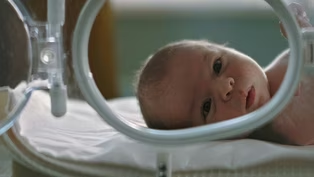
Born to Connect: How Babies Form Early Bonds
Video has Closed Captions
Babies are born wired for connection, and early bonds shape the brain. (2m 46s)
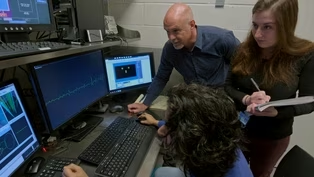
Brain Synchrony: The Secret to Better Teamwork
Video has Closed Captions
Brain synchrony boosts teamwork, trust, and performance. (2m 3s)
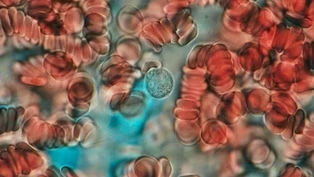
Loneliness and Disease: What the Science Reveals
Video has Closed Captions
Loneliness triggers stress and inflammation, increasing disease risk. (2m 40s)
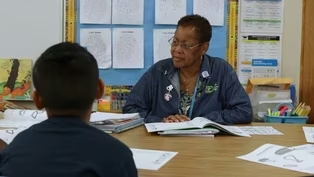
Purpose Can Heal: The Science of Meaning and Health
Video has Closed Captions
A sense of purpose can reduce stress and improve health at a molecular level. (2m 24s)
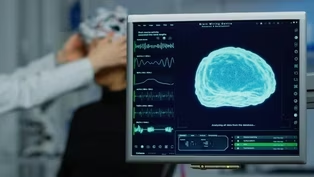
Video has Closed Captions
Scientists now link friendship to a remarkable range of benefits—both physical and mental. (30s)
Providing Support for PBS.org
Learn Moreabout PBS online sponsorship
- Science and Nature

Explore scientific discoveries on television's most acclaimed science documentary series.

- Science and Nature

Capturing the splendor of the natural world, from the African plains to the Antarctic ice.





 New Episode



Support for PBS provided by: